
Hanergy-owned Alta Devices reportedly lays off 250 employees without notice
The U.S. business built and sold record-setting gallium-arsenide solar cells but its parent has seemingly run out of patience. Having failed to give its workers notice of the move, Hanergy is either in contravention of U.S. employment law, ‘faltering’ or subject to ‘unforeseen business circumstances’.

France deployed 707 MW of solar in first nine months of 2019
Solar electricity production increased by almost 9.2% in the January-September period, but installations barely changed from the first nine months of the preceding year.

Spain’s Balearic Islands assign 362 MW of solar in auction
The Spanish government has selected 55 solar installations in the procurement exercise. About 256 MW of the projects it awarded will be built on Mallorca, while Menorca, Ibiza and Formentera will host 61 MW, 6 MW and 2 MW of new capacity, respectively.

Star Wars’ Death Star with PV modules could surpass global energy needs by 10 times
EOn has calculated the number of PV modules that could theoretically be installed on the Imperial space station from the popular film series. It concluded that even a small version of the station would be able to provide enough solar power to supply 2.5 billion households on Earth.
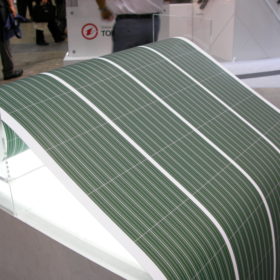
Japanese researchers explain why organic solar cells are damaged by UV light
Scientists have observed that the efficiency of an organic PV device decreases by around 50% when it is exposed to 100-h light irradiation. They attributed this loss to increased resistance of the organic semiconductor layer.
URE to build 193 MW solar park in Taiwan
The Taiwanese PV manufacturer said the project will be the largest solar installation on the island. Construction is scheduled to being near the city of Tainan in the second half of 2020.
Is it worth increasing cell efficiency? A new metric tells you when
A group of scientists is proposing a new metric – the value of efficiency – to calculate the maximum allowable cost to increase a cell’s efficiency and improve the levelized cost of electricity (LCOE). The researchers expect that more regional diversification may be seen at the global level in the years to come, with the proposed metric offering higher values in North America, Central and Northern Europe, Japan, Australia, and New Zealand.

Germany registers 377 MW of new PV in October
Newly installed PV capacity hit 3.33 GW in the first 10 months of this year. Feed-in tariffs will drop in December by another 1% and the 52 GW subsidy cap looms, but for the first time, FITs for all project types are now below the €0.10/kWh mark.
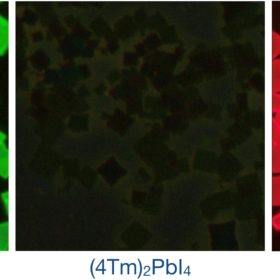
New sandwich-like material for lead-free perovskite solar cells
Scientists from Purdue University claim to have created a new material that incorporates both organic and inorganic materials. Its hybrid structure is said to improve the thermal stability of perovskite PV cells without the need to use lead.

Ireland launches auction scheme for renewables
Solar is included among the competing sources but with a maximum quota of only 10%. Around 13,500 GWh will be allocated across five rounds under the new scheme, which is still subject to EU state aid approval. Community-led projects will be allowed to participate from the second round, with a bonus of €2/MWh.
