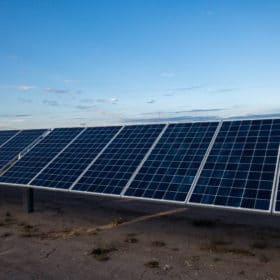
InfraCo, Solvéo secure 25-year PPA for solar park in Guinea
The Khoumagueli Solar IPP project will sell power to local utility Electricité de Guinée (EDG).

Italy allocates 32.2 MW of solar in fifth renewables auction
The auction was, once again, largely unsubscribed. The Italian authorities selected eight solar projects planned in the regions of Emilia-Romagna and Sicily. Enel Green Power was the largest winner with seven projects. The lowest bid came in at €0.0685/kWh.

Spain plans auction to grant grid access capacity to 1.3 GW of renewables
The auction is intended at providing the missing capacity resulting from the closure of the Andorra thermal power plant in Teruel.
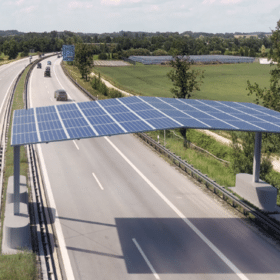
Photovoltaic roof for highways
Researchers from Germany and Austria are testing how photovoltaic roofs may be deployed along highways. The first pilot project is planned to be implemented starting from the autumn.

Applications open for Indian solar manufacturing incentive scheme
Companies can apply for incentives to set up gigawatt-scale solar factories in India. Applications can be submitted until June 30 and the list of successful recipients will be announced on July 26, with letters of award to be issued four days later.
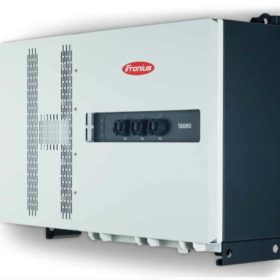
Fronius launches new inverter for large-scale PV plants
The 50 kW version of the new inverter features an efficiency of 98.6% and a European efficiency of 98.1%. It can be deployed with a decentralized approach, next to the PV modules, or centralized, at the grid connection point.
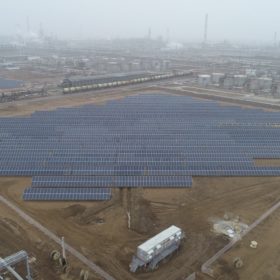
Russian oil giant Lukoil commissions 20 MW solar park
The facility is located on an area of an oil refinery comprising 17 unused sites.
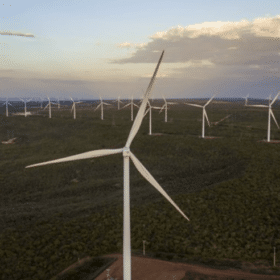
Brazil’s first hybrid wind-solar project
Votorantim Energia and the Canada Pension Plan Investment Board have decided to invest US$35 million in the 68.9 MWac project.

Ever heard of algovoltaics? Enel is testing it for applications on large solar plants
Nicola Rossi, head of innovation at Enel Green Power, has told pv magazine how the company is seeking to combine microalgae cultivation with solar power generation. The integration scheme is aimed at minimizing interferences with the PV plant and maximizing the benefits in microalgae yield
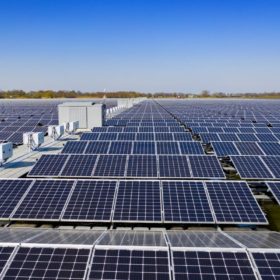
Construction begins on Europe’s largest floating PV plant
The plant is being built by Dutch developer Groenleven on a former sand extraction lake in the northern Netherlands. The company’s project manager for floating PV, Willem Biesheuvel, told pv magazine about its approach to deploying floating arrays always with a west-east orientation, which he claims ensures more stability and resistance to wind and waves.
