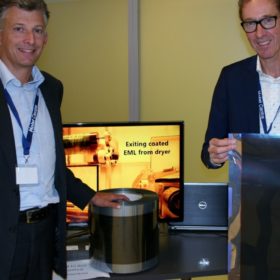
Solliance hits 26.3% efficiency on perovskite/silicon tandem solar cell
European solar research organization, Solliance and the Energy Research Center of the Netherlands (ECN) have announced the achievement of 26.3% efficiency on a transparent perovskite solar cell combined with a crystalline silicon solar cell.

Fixing perovskite defects with potassium
Scientists led by Cambridge University have discovered that adding a simple solution of potassium to the ink solution has the effect of ‘healing’ defects in metal-halide perovskite films, and immobilizing ion movement. This, according to the researchers, could push the material to higher efficiencies, while also increasing stability.
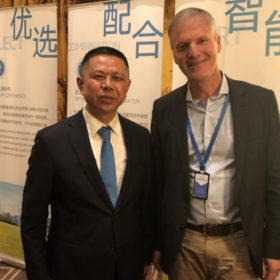
Trina Solar launches TrinaPro Integrated Solution
To mark its 20th anniversary this year, Trina Solar launched its TrinaPro integrated PV solution at a ceremony attended by Chinese and foreign participants. Trina Solar’s founder and CEO, Jifan Gao noted this important move from not only supplying top-notch PV components, such as high-efficiency cells and modules, but also supplying integrated solutions capable of further reducing PV’s already low levelized cost of energy (LCOE).
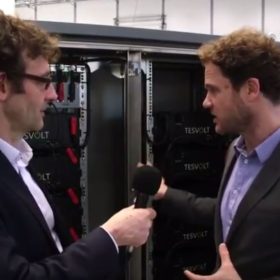
Video: Energy Storage Europe technology tour 2018
If you were unable to make it to Düsseldorf for the recent Energy Storage Europe exhibition and conference, fear not: this 12-minute video tour brings you all you need to know about the latest tech, service and product developments in the European storage space.
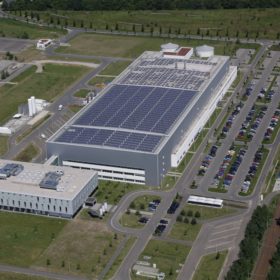
Astronergy announces upgrades to German production line
Module manufacturer Astronergy has announced a series of upgrades contributing to an overall production efficiency increase of 40% at one of its production lines in Frankfurt (Oder), close to Germany’s border with Poland.
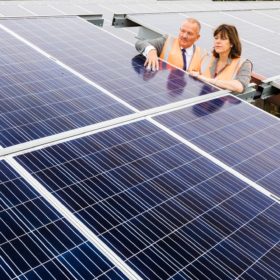
Northwest Europe could install 60 GW of subsidy-free renewables by 2030, report finds
Aurora Energy Research report calculates as much as €180 billion renewable investment opportunities in the region through to 2030, of which €64 billion could be for subsidy-free projects.

Solar on tap: Australia’s Carlton Breweries signs PPA with BayWa r.e. for PV supply
The Melbourne-headquartered brewer will receive solar energy from a 112 MW solar farm located in the state of Victoria, and owned and operated by Germany firm BayWa r.e. The move is part of Carlton’s drive to become 100% renewable.
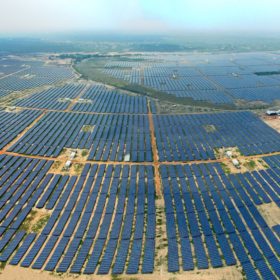
India: Adani to expand its module and cell manufacturing facility to 2 GW
In an exclusive interview, Adani Green Energy Ltd (AGEL) CEO, Jayant Parimal, tells pv magazine the renewable energy company is looking to expand both its module and cell manufacturing capacity to 2 GW. Moreover, it is looking to develop floating solar PV projects in its home market, India, in addition to continuing its focus on the utility-scale solar and wind sectors.
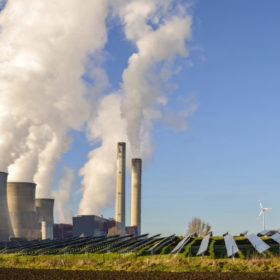
PV has the lowest LCOE in Germany, finds Fraunhofer ISE
According to Fraunhofer ISE experts, PV’s Levelized Cost of Energy (LCOE) currently ranges between €0.0371 and €0.1154 per kWh in Germany. The potential for further cost reductions is vast, the researchers add.

Video interview: Fluence talks peaking capacity at Energy Storage Europe
Praveen Kathpal, Fluence’s VP of Market Applications, explains how the newly formed company – a collaboration between Siemens and AES – is providing flexible peaking capacity to utilities in Southern California, and hears how Europe offers an opportunitiy for the integration of storage into transmission and distribution planning.
