
U.S Researchers look to plant photosynthesis to improve solar efficiency
A team of scientists at Georgia State University has discovered a process that occurs naturally in plants. Known as ‘inverted-region electron transfer’, better understanding of this process could contribute to the design of higher efficiency solar cells, says the University.

DNV GL report criticizes EU demand response regulations
A study carried out by energy consultants DNV GL has found that the European Commission’s draft proposal on demand response regulations is “incompatible with market principles,” and made several recommendations for its improvement.

Intraco Solar Power signs contracts for 30 MW PV plant in Bangladesh
Bangladesh based company Intraco Solar Power has signed a a 20-year PPA and construction agreement with two government agencies, for the development of a 30 MW PV power plant to be located on the outskirts of the city of Rangpur.
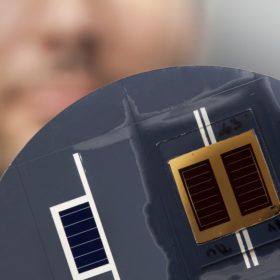
Swiss researchers team with NREL to break 35% cell efficiency
A collaborative project between the U.S. National Renewable Energy Laboratory, the Swiss Center for Electronics and Microtechnology (CSEM) and the École Polytechnique Fédérale de Lausanne (EPFL) has tested a range of multi junction cells in tandem configuration, and achieved efficiencies of up to 35.9%.
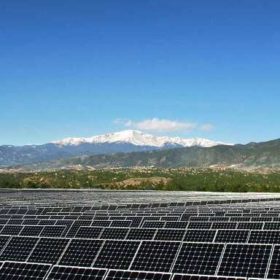
GTM Research: Global solar capacity to rival nuclear by end of 2017
Information from the latest edition of GTM Research’s Global Solar Demand Monitor shows that solar’s globally installed capacity is rapidly catching up with that of nuclear, and that solar could in fact grow to more than double nuclear’s current capacity within the next five years.
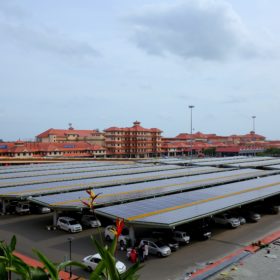
Tata Power Solar reports triple profit, 52 % net sales increase
The solar power arm of the Indian industrial conglomerate Tata has posted a 330% growth in profit after tax in 2016-17, citing EPC instead of manufacturing as the reason behind the increase
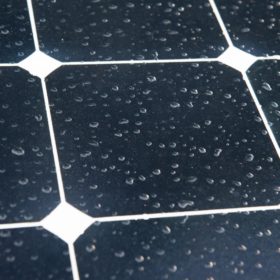
Dutch researchers model perovskite performance
A team of researchers at the Netherlands’ AMOLF institute has modelled the performance of tandem perovskite/silicon solar cells under real-world climate conditions, and found that the tandem cells are little more efficient than the Si cell alone. The research shows, however, that if correctly optimized, this type of cell could perform at efficiency levels above 38%.
IHS Markit raises 2017 global installations forecast
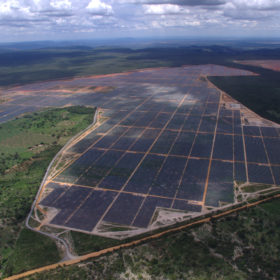
Industry analyst IHS Markit has raised its forecast for global installations in 2017 to 90 GW, representing 14% growth on the previous year’s figures. Continuing demand in China after the June 30th FIT cut is cited as the main driver for the increased expectation.

BIPV: Researchers develop solar glass blocks to power houses
Researchers at the UK’s Exeter University have created solar cell-embedded glass bricks, which in addition to generating electricity let in natural light and provide thermal insulation.
Iberdrola begins construction on first large-scale projects in Mexico
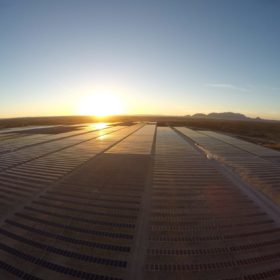
The Spain based multi-national is building two projects in Mexico with a total capacity of 270 MW. Both projects are expected to be operational by the end of 2018.
