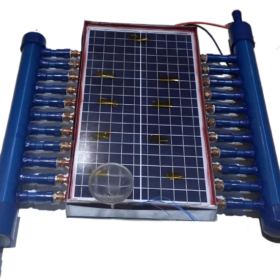
Photovoltaic-thermal panel based on twisted absorber tubes, nanoparticle-enhanced PCM
Developed by scientists in Malaysia, the new PVT system is based on a nanoparticle-enhanced phase change material (Nano-PCM) and twisted absorber tubes. The system consists of a 30 W photovoltaic module, absorber tubes attached to the back of the panel via enhanced silicone glue bond, and a PCM container surrounding the tubes.
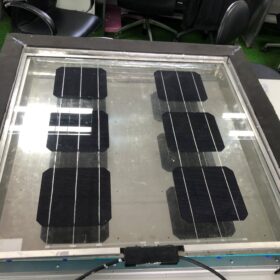
Photovoltaic-thermal panel based on reversed circular flow jet impingement
Developed by scientists in Malaysia, the new PVT collector uses reversed circular flow jet impingement (RCFJI) as a cooling mechanism. Its creators claim the panel may be used for off-grid applications and the generated thermal energy could be used for drying purposes.
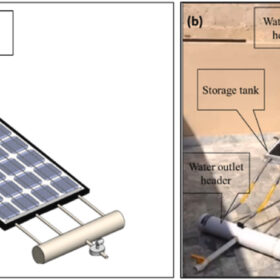
Photovoltaic-thermal solar panel based on water storage tank
A research group from Ireland developed a PVT system consisting of a 170 W photovoltaic panel connected to a water tank placed at the backside of the PV module itself. The PVT module is able to considerably reduce the temperature of the PV unit while producing hot water for residential use.
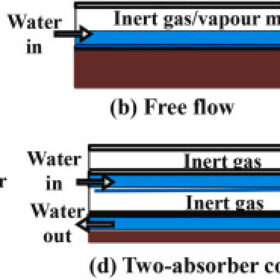
All photovoltaic-thermal system designs at a glance
An international research team has presented all possible system designs and applications for photovoltaic-thermal (PVT) technology. Their review includes conventional PV-T collectors, air-based systems, liquid-based installations, water-based collectors, refrigerant-based systems, heat-pipe-based technologies, dual air-water systems, building-integrated PVT arrays, and concentrated PVT collectors.

German manufacturer achieves 80% overall efficiency with new PVT solar module
Sunmaxx says Fraunhofer ISE has confirmed the 80% efficiency of its new photovoltaic-thermal (PVT) module. It consists of 108 PERC half-cells in M10 format, with 400 W of electrical output and 1,200 W of thermal output.
Solar desalination via photovoltaic-thermal energy
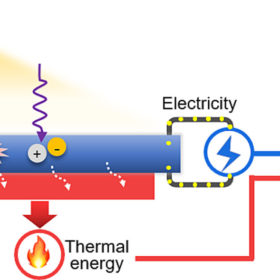
UK researchers have proposed the use of photovoltaic-thermal energy for desalination purposes, via an approach based on synergistic electro-thermal coupling mechanisms. They have found that some system configurations could offer a lower levelized cost of desalinated water, in addition to higher efficiencies.
Photovoltaic-thermal system based on PCM cooling
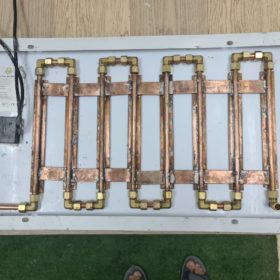
Malaysian researchers have developed a system that can absorb heat from PV modules and transmit it to a nanofluid, in order to transform it into thermal energy and use it for different applications. The panels have an overall efficiency of 89%.
Polypropylene absorber to simplify brine heat pumps’ adoption
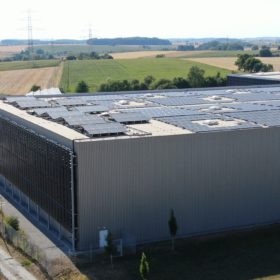
German company Mefa Befestigungs- und Montagetechnik has developed absorbers made of polypropylene that are intended to simplify the use of brine heat pumps. The novel technology should make it possible to combine multiple heat sources, including water, earth, air and also ice storage all within a single system.
Photovoltaic-thermal solar tiles
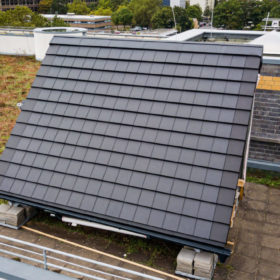
Germany’s Paxos is currently testing the solar tile in a testing facility connected to an air heat pump. The panel can provide heat and electricity at the same time, while also improving the heat pump’s coefficient of performance by around 25%.
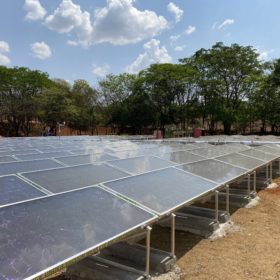
Solar thermal panel for large scale applications
The panel has an absorption area of 1.96 m2 and a weight of 27 kg per square meter. According to the manufacturer – Swiss startup TVP Solar – it may be a real booster for thermal output, by combining it with photovoltaics and heat pumps to provide enhanced output per square meter, in particular for low-temperature applications such as district heating.
