
Advantage of back-contact solar modules in shading scenarios is limited to specific conditions, study finds
Researchers from Trina Solar and China’s Nanchang University claim to have verified that back-contact solar modules outperform TOPCon modules only when fewer than three cells in a substring are shaded. Their findings were published in a peer-reviewed scientific paper.

Automating perovskite solar cell materials research
A Danish research group is working on an automated material discovery and performance optimization platform for perovskite solar cells. The scientists claim a unique combination of robotics, advanced measurement equipment, and machine learning.
How to control frequency fluctuations during PV plant deloading
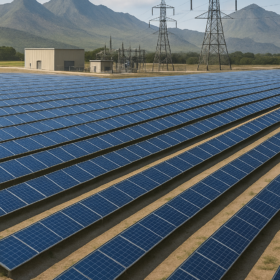
Researchers in Egypt have developed new control strategies for managing frequency fluctuations during deloading of a photovoltaic plant. The proposed methodology combines a proportional–integral controller along with a rate of change of frequency controller.

PV-driven portable air water generator for remote areas
Scientists in Saudi Arabia have created a PV-powered air water generator that can be used in remote areas or on lengthy vehicle journeys. It can reportedly produce a liter of water at approximately $0.04 for packing and zero for non-packing.

Tongwei achieves 31.4% efficiency for perovskite-silicon tandem solar cell
Chinese researchers, led by a research team from PV Technology Center of Tongwei Co., Ltd, used a sequential annealing process in the fabrication of tandem solar cells, featuring a wide bandgap perovskite top cell on a fully-textured commercial crystalline silicon heterojunction bottom cell. The resulting device had a certified power conversion efficiency of 31.4%, outperforming a 29.43%-efficient control cell.
Wave power poised to complement solar PV in future global energy mix
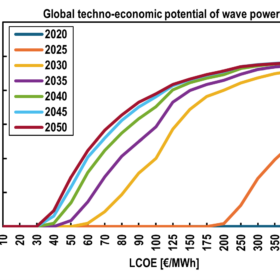
Wave power may emerge as a valuable renewable energy source given recent economic and technical projections indicating a substantial potential of wave energy, particularly in coastal and island regions. Wave and solar resources are complementary around the world and thus may lead to energy systems combining solar PV with wave power. Islands may benefit most from wave power added to solar PV.
Photovoltaics for cocoa pod splitting
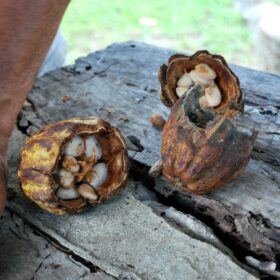
Scientists have designed a cocoa pod splitting device that runs on five monocrystalline PV panels. They have simulated its operation and have found it can achieve a splitting efficiency of 98.92%.
How to store PV power with hybridization of lithium-ion batteries, supercapacitors
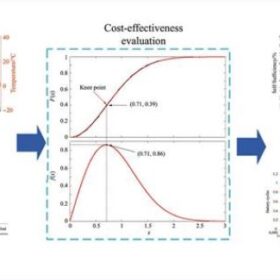
Researchers in Denmark have developed a new sizing strategy to combine PV system operation with lithium-ion batteries and supercapacitors. The proposed approach is claimed to reduce annual battery cycle by 13%.
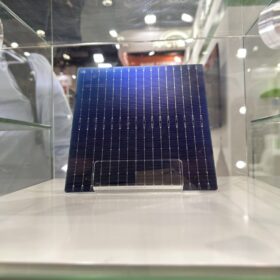
The impact of soldering flux on TOPCon solar cell degradation
UNSW researchers have investigated the impact of two types of soldering fluxes on TOPCon solar modules under damp heat conditions and have found that “no-clean” soldering fluxes can cause severe corrosion of front silver-aluminum contacts. The researchers have also found that denser metallisation structures and lower aluminium content improve corrosion resistance.
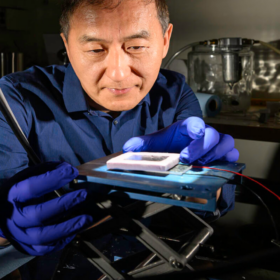
US scientists claim 15-fold performance increase for solar thermoelectric generator
A research team have fabricated a solar thermoelectric generator (STEG) that is reportedly 15 times more efficient than current state-of-the-art devices by concentrating on the managing the hot and the cold sides of the device rather than its semiconductor materials.
