
Video: Fraunhofer ISE outlines 2023 prospects for TOPCon solar modules
Jochen Rentsch, head of department at Fraunhofer ISE, speaks to pv magazine about recent progress in TOPCon module development, including new efficiency records by JinkoSolar and Jolywood. Production costs are falling as more Tier 1 companies shift from PERC to TOPCon, and multi-gigawatt production is already a reality. Could the TOPCon solar cell segment reach a tipping point for efficiency in 2023?
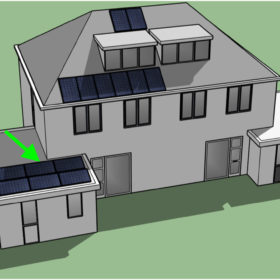
New algorithm to detect shadows in rooftop PV systems
Dutch scientists have developed a new algorithm to isolate shadow-related PV system malfunctions and estimate potential energy losses caused by shadowing.
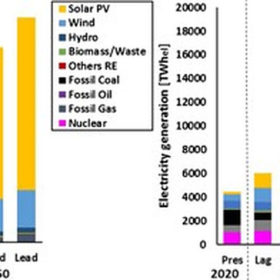
PV could turn Europe into ‘solar-to-X economy’
New research from LUT University shows the central role of solar in Europe’s attempt to reach its 2050 zero-emissions target. It describes how photovoltaics will gradually become the characteristic element of the Old Continent’s emerging energy system by extending its use to the heat and mobility sectors.
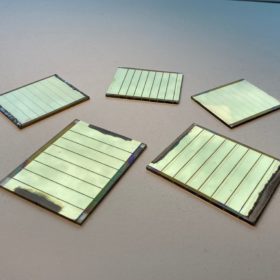
Techniques to build thermally co-evaporated mini perovskite solar panels
Scientists in Singapore have reviewed all thermal evaporation techniques for the production of perovskite solar cells and modules. Despite limitations, the new methods could lead to high production throughputs and more efficient products.
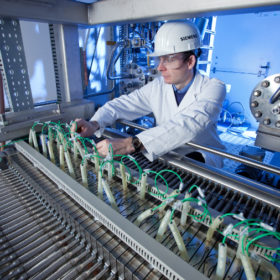
New electrolyzer to split saltwater into hydrogen
Chinese scientists have developed a new way to split seawater into hydrogen without using a separate desalination process. They incorporated a self-breathable waterproof membrane and a self-dampening electrolyte (SDE) into the electrolyzer, so water migrates from the seawater across the membrane to the SDE, without extra energy consumption.
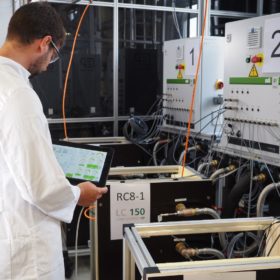
Fraunhofer ISE to develop propane heat pumps for residential homes
Germany’s Fraunhofer Institute for Solar Energy and a group of heat pump manufacturers have started a project to replace gas and oil heating systems in multi-family homes with propane heat pumps featuring low-charge propane (R290) as the refrigerant.

French rail operator to develop solar systems capable of operating at 9,000 V
SNCF Réseau and the National Institute for Solar Energy (INES) in France have agreed to jointly develop renewables projects. They aim to build PV systems that can supply continuous power at voltages of 3 kV, 6 kV, and 9 kV, while optimizing installation costs – particularly with regard to cables, operations, and maintenance.
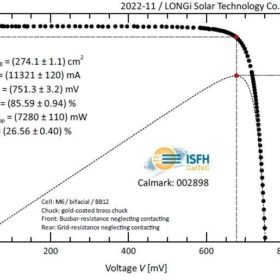
Longi claims world’s highest efficiency for p-type, indium-free HJT solar cells
Longi said it has achieved a 26.56% efficiency rating for a gallium-doped, p-type heterojunction (HJT) solar cell and a 26.09% efficiency rating for an indium-free HJT cell, both based on M6 wafers. Germany’s Institute for Solar Energy Research in Hamelin (ISFH) has confirmed the results.

BIPV shading estimation methods key for uptake, says IEA-PVPS
A recently published report from the IEA-PVPS on building integrated photovoltaics (BIPV) digitalization found many BIPV professionals are unsure of a suitable method for estimating shading in BIPV projects.
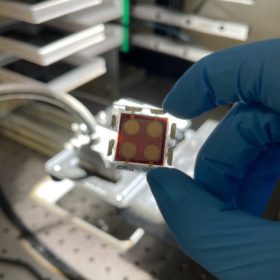
New method brings durability of perovskite solar cells closer to silicon
Researchers from the United Kingdom, the United States and Australia have reportedly developed a perovskite solar cell with comparable stability and durability to commercial silicon PV cells. They used a high-temperature processing method with dimethylammonium chloride to control the intermediate phases of perovskite crystallization.
