
Zimbabwe’s struggle for solar
After several year of stalled and failed projects, Zimbabwe’s government is now seeking to implement existing projects, and to get rid of licensed projects that have never been realized. The first attempt will be pushing forward the 100 MW Gwanda solar project, which had been awarded to Intratek in 2015. The government is further planning to grant incentives to rooftop PV under net metering.
France resumes self-consumption tenders
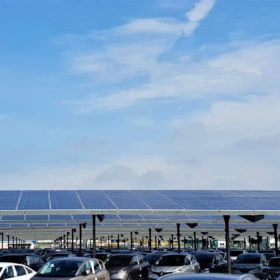
The procurements relate to self-consumption projects with a generation capacity of 100 kW-1 MW. The next tender will be launched in September and will allocate 25 MW of solar capacity. The tenders had been suspended because of low interest and disproportionately high final tariffs for surplus power injected into the grid.
Growth slows in India as developers add 1.7 GW of solar in Q1
The country’s solar installations fell 49% year-on-year in the first three months of 2019, with rooftop PV additions plunging as installers struggled to secure approval for projects immediately before the Indian general election, according to new statistics from Mercom India Research.
Distributed generation the main driver for solar in Japan and the Philippines
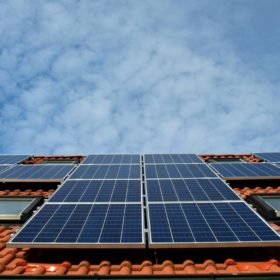
Two reports have concluded rooftop solar may replace PV parks as the main growth driver in the two big Asian markets over the next decade. Support programs for utility scale PV in both countries no longer seem attractive enough.
Sunrun eating into utility operations
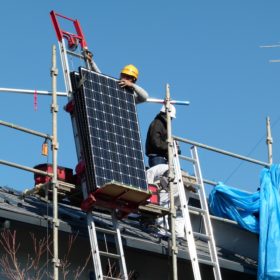
By providing solar-plus-storage, contracting to supply capacity in wholesale markets and even considering microgrid communities, Sunrun is taking on more of the space traditionally occupied by utilities and large, centralized power generators.
Solar distributed generation set for another record year in Brazil
New PV installations under the nation’s net metering scheme grew 137% year-on-year from January to March, according to consultancy Greener, and module imports registered even greater growth, signalling activity in the distributed generation segment is increasing at a faster pace. With the regulator mooting changes to the net metering regime, however, it may reflect customers rushing to secure current tariffs.
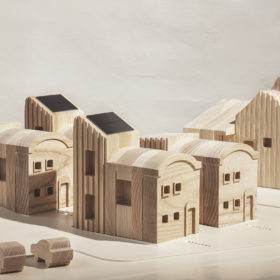
Ikea tests rooftop PV and blockchain on miniature wooden village
The Solarville project, by Ikea’s Danish research and design laboratory, has seen the participation of blockchain companies such as Bloc, Blocktech, WeMoveIdeas India and Temporal. It was conceived to help create cooperative community micro-grids to enable homeowners to become clean energy traders.

Dutch researchers propose new approach to measure solar potential of urban areas
The system is said to have a maximum estimation error of less than 10% and to reduce the computational requirements for calculating the output of PV systems in complex environments. The approach is based on the correlation between a skyline profile and the annual irradiation received at a particular spot.
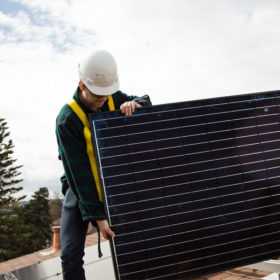
Australia: Federal Energy Minister sends rooftop PV safety warning
At the end of another year or record rooftop PV installations, national Minister for Energy Angus Taylor warns Australian state governments to “consider the potential risks” of rapid solar industry growth.
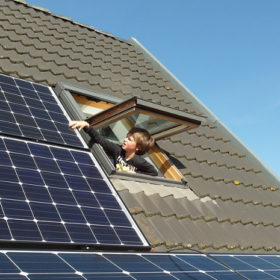
Room for US residential solar to reach 41 GW by 2025
A new analysis by Credit Suisse forecasts that installed residential solar capacity in the United States could grow more than 3x to reach 41 GW by 2025, and shows that there is plenty of space on rooftops to do this.
