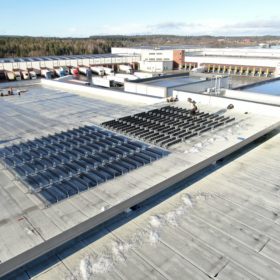
Video: Market outlook for vertical rooftop solar
Norway’s Over Easy Solar AS introduced a new vertical PV system for rooftop applications last year. pv magazine spoke to CEO Trygve Mongstad about system prices and future market prospects for vertical rooftop solar tech.
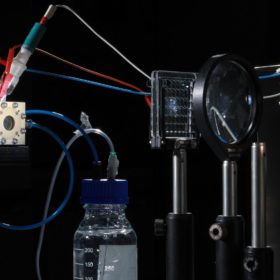
Solar-powered artificial leaf to produce hydrogen from air
Chemical engineers in Switzerland have invented a solar-powered artificial leaf. Their solar-powered, transparent and porous electrode turns water from its gaseous state in the air into hydrogen fuel.

Video: ISC Konstanz director predicts 50% global market share for IBC solar panels by 2030
Radovan Kopecek, the co-founder and director of Germany’s ISC Konstanz, says interdigitated back contact (IBC) tech could account for half of the global market for solar modules by 2030. He says IBC will start to dominate once TopCON and HJT get stuck at certain efficiency limits, and he believes TOPCon will be the first victim.
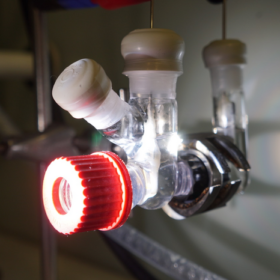
UK researchers develop solar-powered waste-to-fuel system
The University of Cambridge has developed a device that converts plastics and greenhouse gases to usable fuels and products.
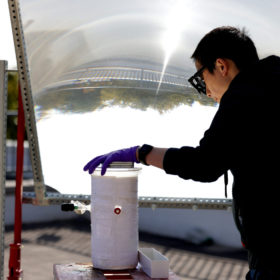
Photocatalytic water splitting with 9.2% solar-to-hydrogen efficiency
A US research team has developed a new technique to produce hydrogen from sunlight and water. It works in an indoor environment and uses pure water, concentrated solar light, and an indium gallium nitride photocatalyst.

Novel database on existing, planned renewables, solar projects in Africa
A new database developed by researchers in Germany includes 1,074 hydropower projects, 1,128 solar plants, and 276 wind power assets, along with geographic coordinates, construction statuses, and capacities for each of them.
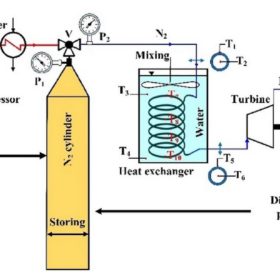
Storing solar power with compressed air storage, air conditioning
Researchers in the United Arab Emirates have developed a way to use compressed air storage to store solar power and provide additional cooling. They claim their prototype could compete with commercially available compression-cooling air conditioners.

Video: TNO expert discusses outlook for future development of solar vehicles
Bonna Newman, program manager at TNO, speaks to pv magazine about the road forward for vehicle-integrated PV, which will likely remain a niche over the short term, despite recent industrial developments. Several companies have started production, but high-volume output and the potential of other PV technologies beyond crystalline silicon remain key challenges for the future of vehicle-integrated solar.
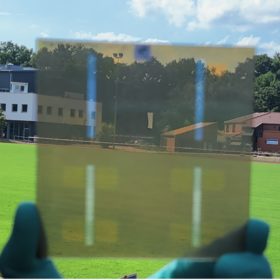
Semi-transparent solar cell based on silicon-germanium quantum wells
German scientists have developed a solar cell with multiple quantum wells to enable higher levels of photocurrent. The 3.4%-efficient device could be used for glass facades in buildings and windows, sunroofs in vehicles, and greenhouses for agrivoltaics.
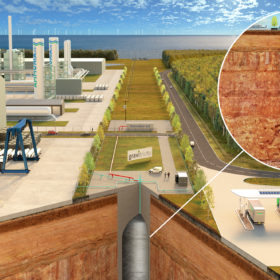
Gravitricity to deploy prototype underground hydrogen storage system
Gravitricity, an Edinburgh-based storage specialist, aims to develop the first full-scale demonstration of its underground hydrogen storage solution by working with structural engineering contractor VSL Systems UK.
