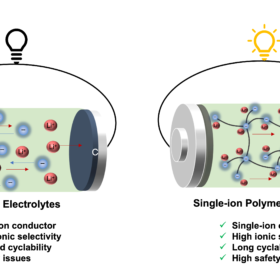
New polymer electrolyte for lithium-metal batteries
Researchers at the University of Hong Kong have discovered a series of anionic network solid electrolytes that can deliver at least a fourfold improvement in cationic transport for lithium-metal battery applications.
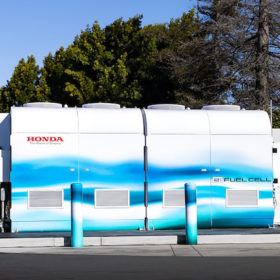
Honda reusing vehicle fuel cells to build 500 kW stationary fuel cell system
Honda has revealed that it is testing a pilot stationary fuel cell stationary power system in California.
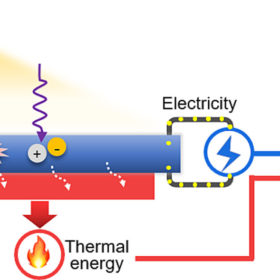
Solar desalination via photovoltaic-thermal energy
UK researchers have proposed the use of photovoltaic-thermal energy for desalination purposes, via an approach based on synergistic electro-thermal coupling mechanisms. They have found that some system configurations could offer a lower levelized cost of desalinated water, in addition to higher efficiencies.

Agrivoltaics can provide food, energy for growing world population
Cornell University researchers have discovered that soybeans planted beneath 3.9-meter-high solar modules can positively affect panel temperatures and the microclimates of farms.
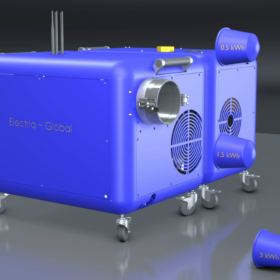
The Hydrogen Stream: Israeli startup to make hydrogen powder in Netherlands
Electriq and Zenith Energy Terminals are teaming up on hydrogen powder production in Amsterdam, while Universal Hydrogen has completed the world’s first passenger flight based on hydrogen fuel cell propulsion.
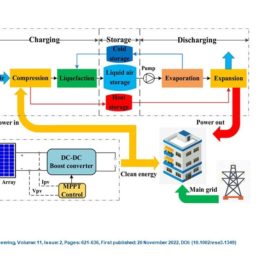
Hybridizing photovoltaics with liquid air energy storage
An international group of researchers has designed a new hybrid photovoltaic-liquid air energy storage (PV-LAES) system. Their economic evaluation for the proposed 2 MW PV-LAES project showed that the investment payback period can be within 10 years, and the accumulated net profit can reach up to $2.2 million from a life-cycle perspective.
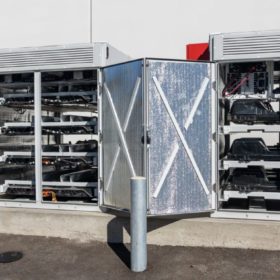
Second-life EV batteries as grid-scale storage
Smartville has secured $5.9 million from the US Department of Energy to scale its second-life battery program.
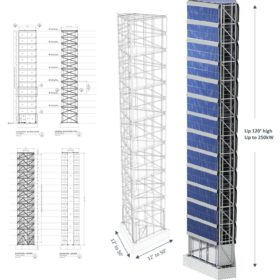
Solar tower of power shows benefits of vertical installations
Three Sixty Solar, a commercial and utility-scale solar developer, published a report this week that provides background on its vertically mounted solar system’s initial 16 months in operation.
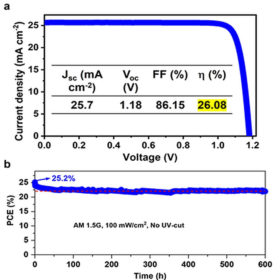
Perovskite alkylammonium chloride solar cell achieves 26.08% efficiency
The US National Renewable Energy Laboratory (NREL) has certified that a South Korean research team has achieved a 25.73% efficiency rating with a perovskite PV cell based on alkylammonium chlorides. The champion device built by the scientists reached an efficiency of 26.08%.
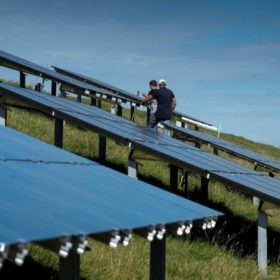
Dutch study confirms feasibility of PV plants on dikes
A Dutch consortium recently tested four different PV system configurations along water in the Netherlands. The country has approximately 17,000 km of dikes and a preliminary study has shown that they offer the potential for 11 GW of solar capacity.
