Paths to commercial success for renewable energy tech
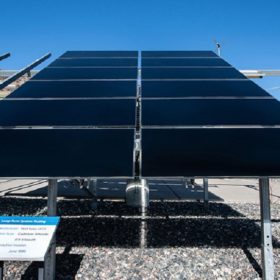
Analysts have studied lab-to-market pathways for clean energy technologies, including First Solar’s cadmium-telluride thin-film solar modules.
Selenium solar cell with 5.2% efficiency, 0.99 V open-circuit voltage
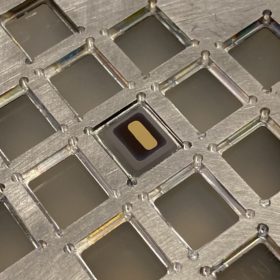
Danish researchers have built a selenium solar cell with the highest open-circuit voltage ever reported. They said that with further improvements in the optoelectronic quality of selenium, the device could reach an efficiency of up to 8%.
Monolithic perovskite-silicon tandem solar cells for water splitting
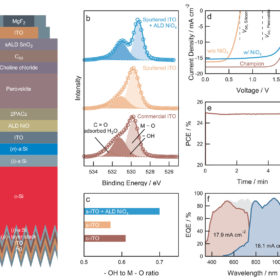
Researchers in the Netherlands have designed a water-splitting system with an electrochemical cell and a 25%-efficient tandem perovskite-silicon solar cell. It can reportedly achieve a solar-to-hydrogen efficiency rating of more than 21%.
Thin-film tin sulfide solar cells with high open-circuit voltage
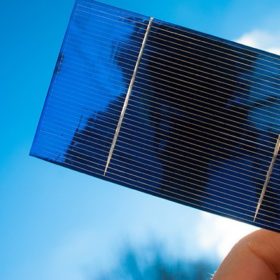
Japanese researchers claim that tin sulfide solar cells could achieve higher open-circuit voltages by preventing “Fermi level pinning” from occurring, due to the addition of a tin sulfide interface with large band bending.

Design framework for BIPV shading devices
Canadian researchers have developed a new model to improve the performance of building-integrated PV (BIPV) shades in buildings. They considered solar electricity, heat transferred through windows, and interior daylighting quality.
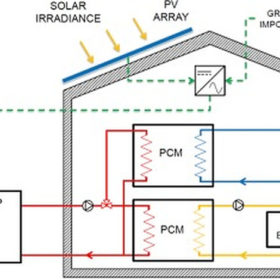
PV-powered residential air-source heat pump with PCM thermal storage
A UK research group has proposed the combination of solar-powered heat pumps and thermal storage based on phase-change materials for residential applications. They said such a system could facilitate cost savings of up to 39%.
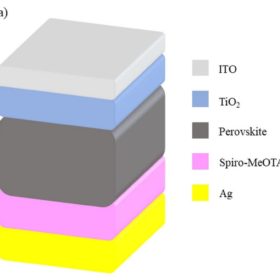
Natural-born p-doped material for pervoskite solar cells
Researchers in South Korea have found that molybdenum ditelluride could increase carrier generation in perovskite solar cells. They simulated a cell with a perovskite absorber and a layer made of the new material, and determined that its efficiency could exceed 20%.
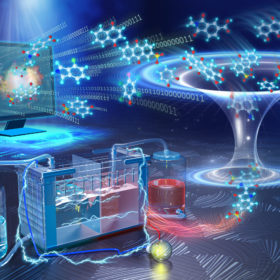
Scientists identify molecules for potential use in redox flow batteries
Scientists at the Dutch Institute for Fundamental Energy Research (DIFFER) have set up a database of 31,618 molecules that could potentially be used in future redox flow batteries. They used artificial intelligence and supercomputers to identify the properties of the molecules.
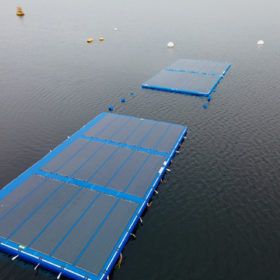
Dutch developer secures funds for flexible floating solar pilot in North Sea
Bluewater Energy Services has won a grant from the Dutch government to build a flexible floating solar demonstration project in the North Sea. The system uses flexible thin-film PV modules and flexible floaters that move with the waves.
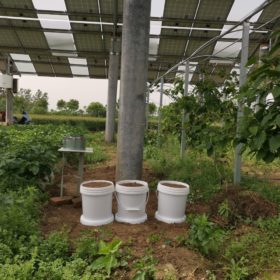
Agrivoltaics to reduce water evaporation
Chinese scientists assessed water evaporation on plots of land covered by two different kinds of agrivoltaic arrays and managed to significantly reduce evaporation in both cases. They looked at the relationship between cumulative surface evaporation and evaporation time.
