Perovskite solar cell defect characterization during manufacture for improved stability
A novel electrochemical robotic arm is under development at the University of Arizona to identify perovskite defects during manufacturing rather than after to improve durability.
UPDATED – New tech to produce hydrogen from tap water
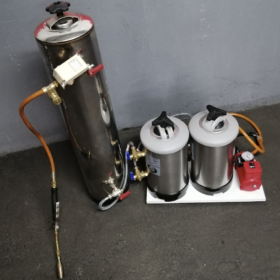
A Spanish scientist has developed a system that reportedly produces hydrogen on-site without expensive electrolysis. The prototype utilizes a water tank that is initially filled with water, ferrosilicon, and sodium hydroxide.
Cooling down solar modules with cotton wicks immersed in water
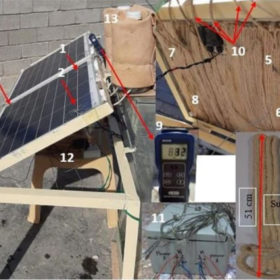
The novel technique consists of attaching cotton wicks immersed in the water (CWIWs) to the backside photovoltaic module. The water is supplied to cotton wicks from top to bottom by gravity which the scientists said helps the effective absorption of cotton and reduces water consumption.

Vehicle-integrated photovoltaics for low-speed electric vehicles
Canadian startup Capsolar claims its flexible solar modules can be adapted to any type of low-speed electric vehicle with no extra modification and custom work. The panels have an efficiency of 21.3%.
Solar thermal panel for large scale applications
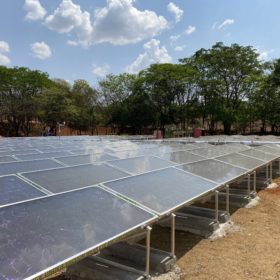
The panel has an absorption area of 1.96 m2 and a weight of 27 kg per square meter. According to the manufacturer – Swiss startup TVP Solar – it may be a real booster for thermal output, by combining it with photovoltaics and heat pumps to provide enhanced output per square meter, in particular for low-temperature applications such as district heating.

New kind of black silicon shows improved light-trapping properties
Scientists in Russia have developed a new wide-band optical absorber called ‘black silicide’ which they claim is more adjusted to match AM-1.5 solar spectrum with theoretically higher photogenerated current density. It could be used for tandem operation in photovoltaic devices.
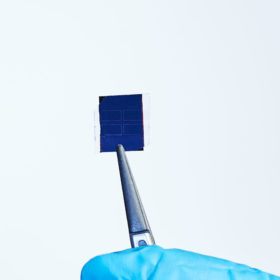
Monolithic perovskite-silicon solar cell with 20% efficiency via new lamination approach
The solar cell achieved an open-circuit voltage of 1.75 V, a short-circuit current density of 15.5 mA cm−2, and a fill factor of 73.6%. It was also able to retain 93% of its initial efficiency after 100 hours at a temperature of 80 C.
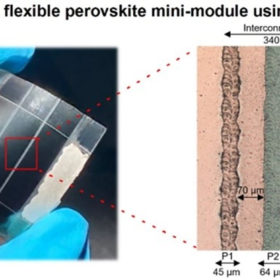
Four-terminal flexible perovskite-CIGS tandem mini-module with 18.4% efficiency
Swiss scientists have built a 4T tandem perovskite/CIGS mini-panel with a geometric fill factor of over 93%. It combines a 10.8%-efficient mini perovskite module and a 15.1%-efficient CIGS device.

New photovoltaic tiles from Estonia
Estonian startup Solarstone has developed two solar tiles with an efficiency of up to 19.5% and an operating temperature coefficient of -0.41% per C. It recently secured €10 million in funds to expand sales across Europe.

PEM fuel cell with novel biomimetic design
Spanish scientists developed a proton exchange membrane fuel cell with a bipolar plate based on a nature-inspired structure. This architecture, according to its creators, shows remarkable performance when operating at high relative humidity values of 90%.
