
Agrivoltaics for hop growth
France’s Q Energy has developed a new way to combine solar generation and the cultivation of hops, which can grow up to 8 meters in height. The agrivoltaic system consists of two mounting units with 52 bifacial PV modules.
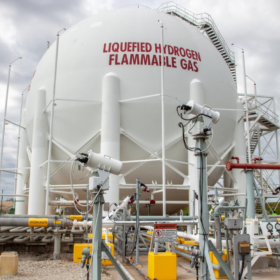
The Hydrogen Stream: Romania calls for green hydrogen projects
Romania has unveiled a state aid scheme to support investments in the production of hydrogen powered by solar, hydro and wind, while Air Products and Gunvor have agreed to build a hydrogen import terminal in Rotterdam.
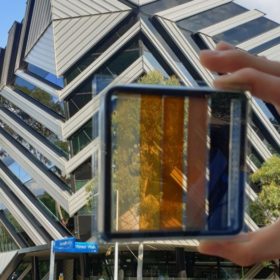
Semi-transparent perovskite solar cell for window applications
Buildings, particularly those with glass facades, are getting closer to self-powering, according to Australian scientists who recently developed a 15.5%-efficient, semi-transparent solar cell that allows more than 20% of visible light to pass through.
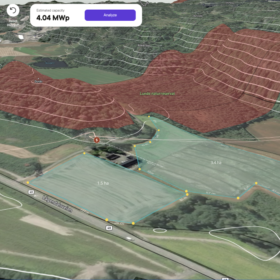
New software to identify solar-suitable surfaces
Norway’s Glint Solar has developed cloud-based software that finds suitable surfaces for solar parks. It analyzes factors such as the distance to the grid or substations, topography, soil depth, and solar radiation. The tool can also be used for preliminary project sizing.
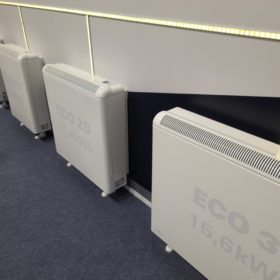
Solar-powered residential heating system based on storage heaters
Spanish heating specialist Elnur Gabarron offers a residential heating system that works with surplus solar power and storage heaters. The system can work as a backup solution, combined with existing conventional heating, or as a household’s main heating system, with minimal use of grid electricity.
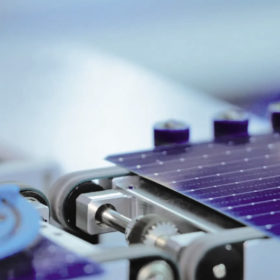
Perovskite-silicon tandem solar cell with TOPCon structure hits 27.6% efficiency
A research group led by Chinese manufacturer JinkoSolar has developed a tandem perovskite-silicon cell with a subcell based on TOPCon tech. The group succeeded in reducing voltage losses in the silicon sub-cell by minimizing the shunting probability during device fabrication.

Storing solar power via borehole thermal energy storage
A Chinese-Finnish research group has proposed the use of seasonal, soil-based thermal energy storage in combination with photovoltaics in residential districts. They have found that the hybrid concept could cover up to 58% of total heating demand.
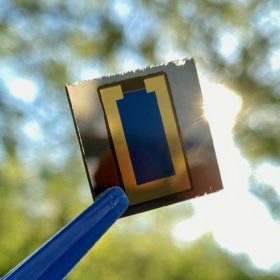
Perovskite-CIS tandem solar cell with 24.9% efficiency
A Dutch-German research team has developed a new PV cell with a certified efficiency of 23.5%, an open-circuit voltage of 1.59 V, a short-circuit current of 19.4 mA cm–2, and a fill factor of 75.5%. It reached maximum efficiency of up to 24.9%, due to the high quality of the subcells.
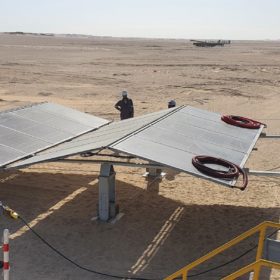
Mobile solar-plus-storage unit for offgrid applications
Enerwhere has designed a solar-plus-storage mobile unit for offgrid locations such as oil and gas fields and construction sites. It can be adapted to different needs and is scalable up to megawatt-scale projects.
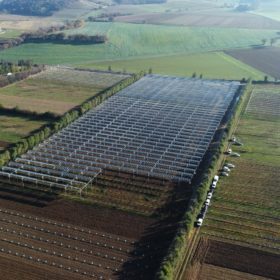
Romania introduces new rules for solar on agricultural land
Romania is set to put new solar regulations into force through the end of 2026. The rules will allow PV, wind, biomass, bioliquid, biogas, storage projects, and transformer stations to be built directly on land in several previously prohibited fertility classes.
