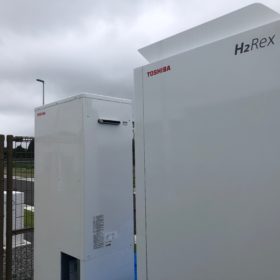
Toshiba’s power and heating hydrogen solution
The Japanese electronics giant has deployed a 3.5 kW hydrogen fuel cell system for at its Michinoeki-Namie site in the Fukushima prefecture. The fuel will be provided by the company’s 10 MW Fukushima Hydrogen Energy Research Field nearby.

Testing CPM-based passive cooling for CPV systems
An international research team has tested change material heat sinks for heat management on a concentrator photovoltaic system. It found that increasing over height ratios lowers the formation of stratified liquid layers, which in turn reduces the potential hot spots in the upper part of the solar cell.

Solar modules with glass-enameled steel backs
U.S.-based Toledo Solar has secured a grant from the U.S. Department of Energy to conduct research on lighter, steel-backed solar modules.
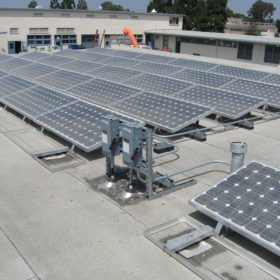
Photo-electrochemical cells vs. PV electrolysis
Dutch researchers have analyzed the two most promising solar-assisted technologies to produce green hydrogen, based on the levelized cost of hydrogen. They found that PV-powered hydrogen production offers the lowest costs, at $6.22/kg, with a solar-to-hydrogen efficiency ratio of 10.9%.
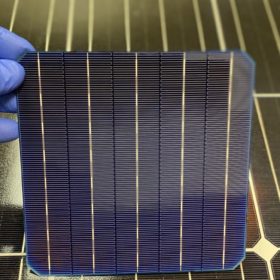
New PV cell architecture creates resistively bounded subcells
Solar Inventions, the winners of the first American-Made Solar Prize, plan to commercialize their newest product, which is claimed to reduce silver content and increase module power, while potentially saving manufacturers up to $1 million per year.
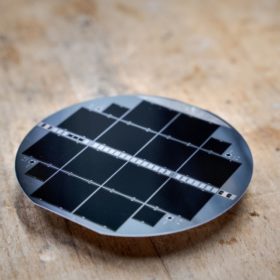
Fraunhofer ISE claims 25.9% efficiency for III-V tandem solar cell
The new results mark an improvement on the institute’s previous 24.3% efficiency record. The III-V tandem solar cell is directly grown on silicon.
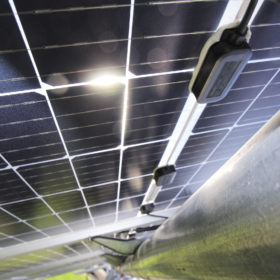
New method to calculate solar irradiation on rear side of bifacial panels
Researchers have announced a new technique that is a modified version of the isotropic diffuse model.
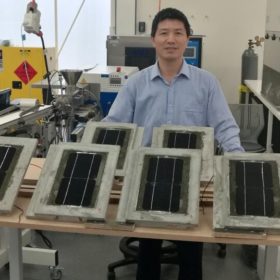
Solar tile with passive cooling
Researchers built the device by attaching 17%-efficient monocrystalline PV cells to a mortar roof tile that was doped with a phase-change material (PCM). The PCM solar tile provided 4.1% more power than the PV tile with no cooling agent in the winter, and 2.2% to 4.3% more during the summer.
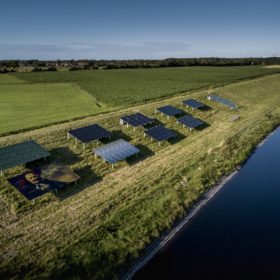
Challenging plans to deploy PV on dikes
Dutch researchers are trying to determine whether large-scale PV projects can be deployed on flood-control dikes across the Netherlands. A 5 MW solar project has already been built on a dike near Groningen, but the researchers believe there is potential to build up to 2.9 GW of PV on such embankments.
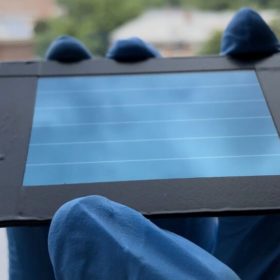
‘Spontaneous de-doping’ for 17.8%-efficient perovskite mini-module
U.S. scientists have found a new ‘de-doping’ process in perovskite solar cells that could cut production costs and produce better devices. They have used this to fabricate a mini-module with 17.8% efficiency.
