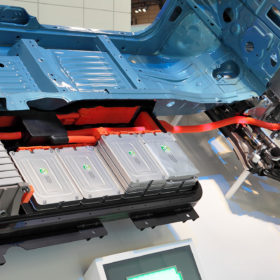
Used EV batteries for large scale solar energy storage
MIT scientists have suggested used electric vehicle batteries could offer a more viable business case than purpose-built systems for the storage of grid scale solar power in California. Such ‘second life’ EV batteries, may cost only 60% of their original purchase price to deploy and can be effectively aggregated for industrial scale storage even if they have declined to 80% of their original capacity.
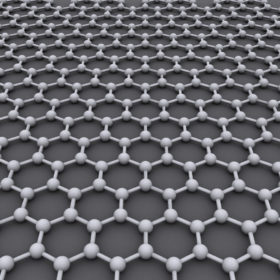
Investors bet $27.5 million that Nanotech Energy’s graphene battery breakthrough is the real thing
The startup claims to be “the world’s top supplier of graphene” and plans to release a non-flammable, environmentally friendly lithium battery that can charge “18 times faster than anything that is currently available on the market” — within the next year.
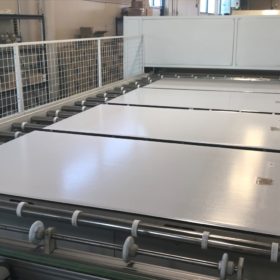
New solar module backsheet based on polyamide
Backsheet manufacturer Tomark-Worthen LLC has developed a new polyamide backsheet under the U.S. Department of Energy’s Sunshot initiative. The product is based on a novel polyamide-ionomer alloy created by U.S. chemicals producer Dow. The alloy, as well as the other materials in the backsheet, are stabilized with a UV/anti-oxidant package that slows down the damaging effects of ultraviolet radiation. The manufacturer claims that the backsheet is 25-30% more affordable than high-efficiency fluoropolymer products.

Harvesting electricity from shadow
Researchers in Singapore have created a device that can produce electricity from the contrast in illumination between lit and shadowed areas under weak ambient light. Although not directly related to solar, this new technology opens up new horizons for producing clean energy under indoor lighting conditions.
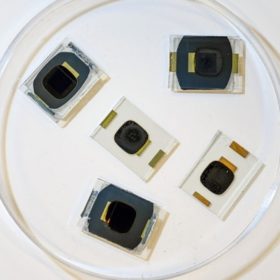
Australian scientists claim breakthrough in perovskite stability
In a world-first, perovskite solar cells developed by Australian scientists have passed a series of heat and humidity tests using a low-cost solution to overcome some of the challenges that are hindering the technology’s commercialization. The scientists did this by suppressing the decomposition of the perovskite cells using a simple, low-cost polymer-glass blanket.

Borehole thermal energy storage for solar
The municipality of Drammen, Norway, has started testing a seasonal PV storage project that uses boreholes in the ground. The operators of the project are using electricity from PV modules to produce heat via a CO2 heat pump and outdoor air. The heat is produced by the CO2 pump during the spring, summer and fall, in addition to heat produced by solar thermal collectors.
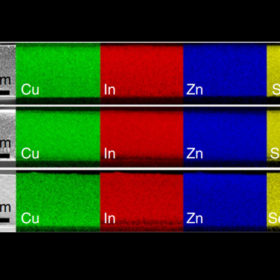
Lead-free quantum dot solar cells with 10% efficiency
Scientists in the United States have created a quantum dot solar cell which has a photon-to-electron conversion efficiency of 85%. The device is also said to exhibit remarkable defect tolerance and toxic-element-free composition.

A pressure-assisted technique to increase perovskite solar cell efficiency
Researchers in the United States claim to have significantly increased the efficiency of a perovskite solar cell by applying a range of pressures to the device. According to them, pressure-assisted processes such as lamination, cold welding and rolling/roll-to-roll processing can be used to improve interfacial surface contacts in perovskite cells.
New method for life cycle assessment of PV technologies
Researchers in Australia have conducted a ‘cradle to grave’ life cycle assessment (LCA) of the four most widely used PV technologies. The academics say that cadmium telluride solar modules have the lowest life cycle impact, followed by amorphous, multi and monocrystalline silicon products.
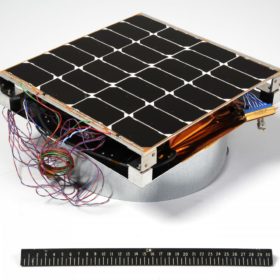
A PV antenna for solar power beaming from space to Earth
Researchers from the U.S. Naval Research Laboratory have launched first orbital experiment with space-based solar power. They have sent into space a 12-inch square tile photovoltaic module that is expected to test the viability of space-based solar power systems converting sunlight to microwaves outside the atmosphere.
