
Exciting excitons
A research team from Columbia University has designed organic molecules that can produce excitons with a longer lifecycle than inorganic equivalents. The excitons have the potential to amplify the amount of electricity generated by the photons a solar cell absorbs.

A new spectroscopic method to understand the physical principles of organic PV
A German research team claims to have created a new visualization technique it says can enable detailed mapping of the energetic landscapes of organic PV cells on a nano scale. The technique could lead to organic cells with reduced power losses.
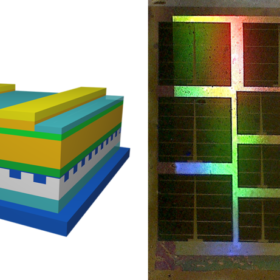
German-French scientists develop ultra-thin GaAs solar cell with 19.9% efficiency
The researchers have developed a new manufacturing process by using an ultra-thin absorbing layer made of 205-nanometer-thick gallium arsenide (GaAs) and a nanostructured back mirror.
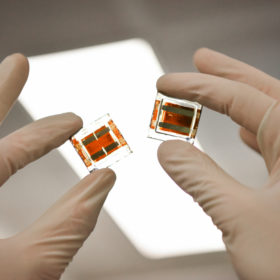
Copper iodide, another option to stabilize perovskite cells
A research team from Russia’s institutes NUST MISIS and IPCE RAS, and Italy’s University of Rome Tor Vergata, have applied an additional layer of p-type copper iodide semiconductor between perovskite and the hole-transport NiO layer of the cell. According to the scientists, this inorganic material is more accessible and easy-to-use.
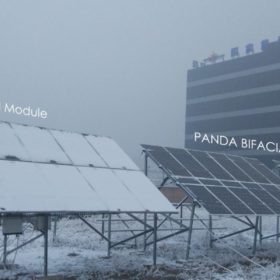
New York’s winter solar duck curve is on the way
A site origination exercise and load analysis by Cornell University suggests 9 GW of solar will reduce peak demand in New York by nearly 10%. However it also found solar needs better capacity valuations to make for a stronger market, and will drive a winter time duck curve during a season of lower electric demand.

Scientists cast light on how potassium can fix perovskite cells
Doping perovksite solar cells with potassium is said to eliminate interface trapping defects and mobile ion migration. ‘Hysteresis suppression’ is key for more efficient cells based on the promising material.

UK scientists build new 3D solar architecture
The back-contact solar cell is said to have a conversion efficiency of around 7%. According to researchers, the cell design includes the removal of expensive transparent conductive oxides.
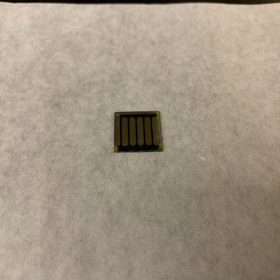
Enhancing perovskite cell performance with coffee
A U.S.-Chinese research team has discovered that carbonyl groups in caffeine can increase the efficiency of perovskite solar cells from 17% to 20%. The peculiar molecular structure of caffeine is said to be a good match for the precursors of perovskite material compounds.
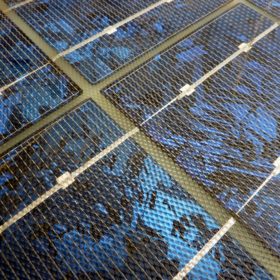
Taiwan’s PVEVL expands performance tests to perovskite, quantum dot and organic solar cells
Despite the difficulties its solar manufacturing industry faces, the Taiwanese government is ramping up its R&D efforts to measure the efficiency of what it calls “new-generation light-driven photovoltaics”.
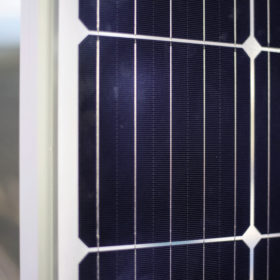
European researchers seek standard to assess short-circuit current temperature of PV devices
A European research team working on the EU-funded EURAMET ENG55 “PhotoClass” project has taken a step toward standardizing the measurement of the relative temperature dependence of the short-circuit current in different PV devices, although it applied completely different approaches.
