Solar module prices lagging behind soaring silver costs
Solar manufacturers are facing rising cost pressure as silver paste now accounts for up to 30% of total cell production costs. OPIS analyst Hanwei Wu tells pv magazine that module producers currently have limited ability to raise panel final prices, which is accelerating efforts to reduce silver use across all mainstream cell technologies.

Rising silver prices drive China’s Longi shift to copper-metallized solar cells
China’s Longi says it will begin mass production of base-metal PV modules in the second quarter of 2026 as rising silver prices intensify pressure to reduce metallization costs.
Silver hits record high of $83.62 an ounce
Silver prices have surged to record levels over the past week, surpassing $80 an ounce after China said it plans to restrict silver exports in 2026.

Chinese PV Industry Brief: DKEM files patent lawsuit against silver paste rival
Wuxi DK Electronic Materials (DKEM) has filed a patent lawsuit against Zhejiang Guangda Electronic Technology over alleged infringement of its conductive silver-paste patents.
Mexico leads Latin American countries in global silver production
Commodity Trading Club (CTC) says Mexico, Peru, Bolivia, Chile, and Argentina together supply more than half the world’s silver output, a cornerstone metal for solar and clean-tech industries.
Forschungszentrum Jülich achieves 23.08% efficiency for copper-metallized heterojunction solar cell
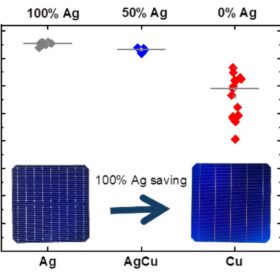
The cell reportedly exhibits only a 0.4% efficiency loss compared to a reference device that underwent full silver metallization.
Silver prices surge, yet ‘thrifting’ poses little threat to solar cell, module quality
With silver prices nearing $50 per ounce, researchers from the University of New South Wales (UNSW) and the Fraunhofer Institute for Solar Energy Systems (Fraunhofer ISE) tell pv magazine that efforts to reduce silver use in solar cells will not compromise module quality if properly engineered.
Silver price surge drives PV makers to cut silver usage further
The price of silver rose above $44 per ounce this week after gaining more than 30% in six months, with silver expert Philip Newman telling pv magazine it could exceed $50 per ounce next year, raising pressure on PV module makers to curb silver use.
Copper-metalized heterojunction solar cells close to achieve same efficiency as silver-based counterparts
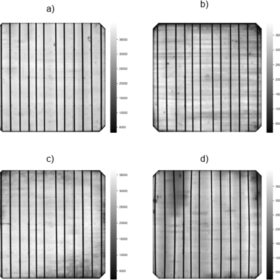
Researchers in Germany have shown that heterojunction solar cells screen printed with silver-copper on the front side and silver paste on the rear side can achieve a 0.13% efficiency gain over reference screen-printed bifacial cells based on silver alone. The research group worked specifically on dispensing and screen printing as printing methods.
PV industry could account for 40% of global silver demand by 2030
New research from Europe shows that the global PV industry may require up to 14,000 tonnes of silver per year in 2030, with global supply being only 34,000 tonnes. The scientists said more efforts should be made to reduce silver content in TOPCon and heterojunction solar cells.
