Agrivoltaics for soybeans
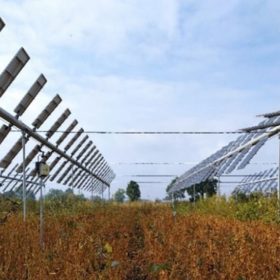
Italian researchers have looked at how soybeans could be grown in agrivoltaic installations and have found that the impact of shading is less significant than previously believed.
Novel agrivoltaic array tech for greenhouses
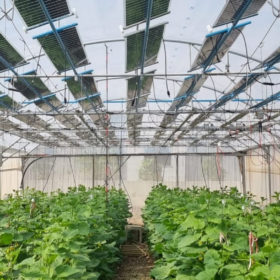
An Israeli startup is commercializing crop-responsive PV trackers for greenhouses. The system includes a tracking structure, a motor, a controller, and specially designed solar panels.
Agrivoltaics for strawberries
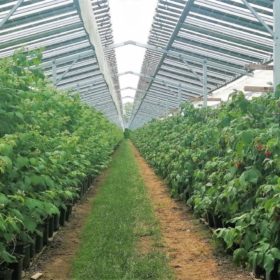
In June 2020, German developer BayWa r.e. inaugurated its largest agrivoltaic power plant in the Netherlands, with a capacity of 2.7 MW. pv magazine France looks at the economic model.
New models to predict crop yields in agrivoltaics
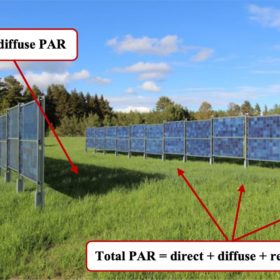
A Swedish-Italian research group has applied state-of-the-art models for global horizontal irradiance decomposition to assess photosynthetically active radiation in agrivoltaic projects – an important variable to properly predict crop yield.
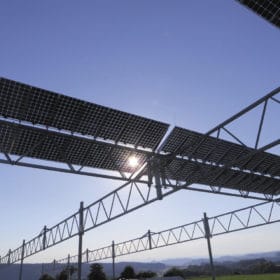
New method to evaluate performance, LCOE of elevated agrivoltaics
Scientists in Belgium have developed a way to assess elevated agrivoltaic projects, by calculating key performance indicators such as energy yield and levelized cost of energy (LCOE). They have found that shade-tolerant crops such as potatoes could potentially be paired with around 1,290 GW of PV capacity in Europe.
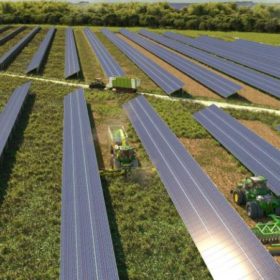
Agrivoltaics adding value to crops with low agricultural yield
A group of 35 French agricultural entrepreneurs decided to change their agricultural practices to adapt to the low quality of their groundwater and chose agrivoltaics as a way to compensate for crop yield losses.
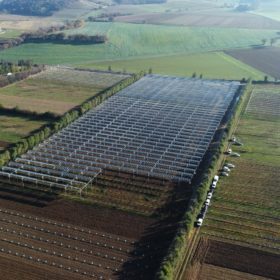
Romania introduces new rules for solar on agricultural land
Romania is set to put new solar regulations into force through the end of 2026. The rules will allow PV, wind, biomass, bioliquid, biogas, storage projects, and transformer stations to be built directly on land in several previously prohibited fertility classes.

Agrivoltaics for rice growers
East-West Power has switched on three 100 kW agrivoltaic arrays at rice plantations in South Korea. It placed the solar modules at a height of 4 meters to enable the passage of heavy machinery.
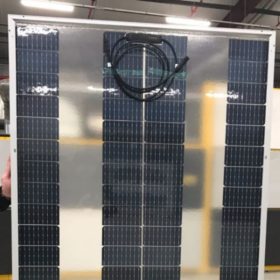
Smarter E Products: Voltec Solar presents bifacial solar module for agrivoltaics
The solar modules feature different levels of transparency and the 280 W version has a power conversion efficiency of 13.40% and a temperature coefficient is -0.324% per C. It measures 2,005 mm x 1,042 mm x 35 mm and weighs 23 kg.
France defines standards for agrivoltaics
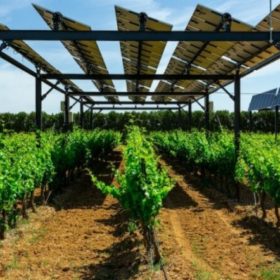
France’s environmental agency Ademe has released a set of new guidelines that clearly define “agrivoltaics.”
