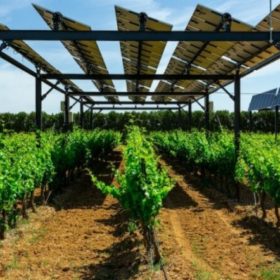
France defines standards for agrivoltaics
France’s environmental agency Ademe has released a set of new guidelines that clearly define “agrivoltaics.”
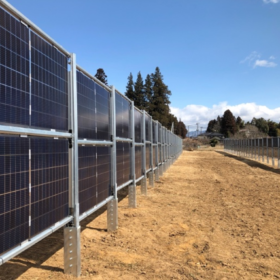
Japan’s first vertical agrivoltaic project
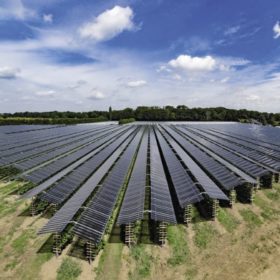
The facility was built with heterojunction modules and mounting systems provided by German companies Luxor Solar and Next2Sun, respectively. The distance between the panel rows ranges from 8 to 10 meters and the agricultural surface within the rows will be utilized by local livestock farmers as pasture.
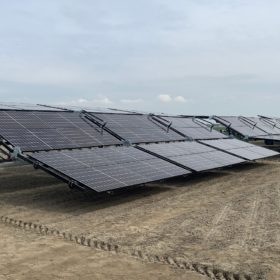
Mobile agrivoltaic system from the Netherlands
Created by a Dutch group of companies and research institutions, the mobile solar system may also be combined with an electrolyzer for hydrogen generation. Two prototypes are currently being tested by a farmer and a research institute in the Netherlands.
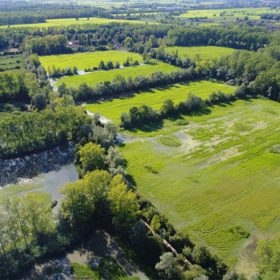
Italian research agency ENEA launches call for innovative agrivoltaics
The agrivoltaic facility may have a capacity of 1 to 3 MW and will have to be designed to comply with landscape requirements and the agricultural practices of NeoruraleHub, which applies a blue economy model to agriculture.
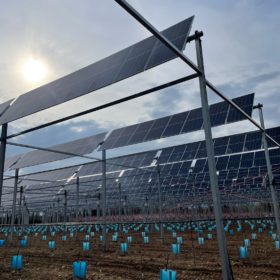
Agrivoltaics for stone fruits
French specialist Sun’Agri is developing a pilot project to combine solar power generation with the cultivation of peaches, apricots, and cherries.
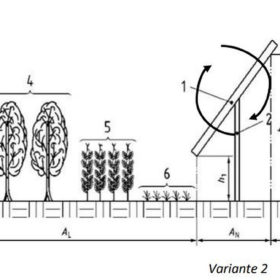
Italian solar sector defines standards for agrivoltaics
A document compiled by three Italian renewables associations identifies with extreme precision the area that is allowed to be used for power generation in the two most common agrivoltaics configurations — solar arrays with elevated solar modules and PV systems deployed between crop rows.
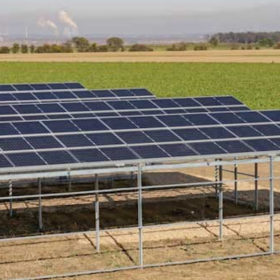
New agrivoltaic system design from Germany
Germany’s Sunfarming is testing the new project design in cooperation with research centers Jülich and the Fraunhofer ISE.
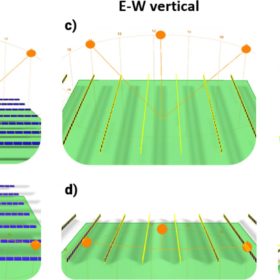
Optimal topology for agrivoltaics based on bifacial PV modules
A research team has outlined an optimized array topology for agrivoltaic projects built with bifacial modules. According to its findings, the benefits of bifacial PV arrays are most prominent in stilt mounted projects, where modules are elevated considerably off the ground at over 2 m, thus allowing plenty of light to be absorbed by the rear PV side as well.
Israel launches tender for 100 MW of agrivoltaics
Selected projects will be awarded a fixed tariff of ILS 0.2091 ($0.06.708)/kWh over a 23-year period.
Vietnamese manufacturer unveils PV module for agrivoltaics
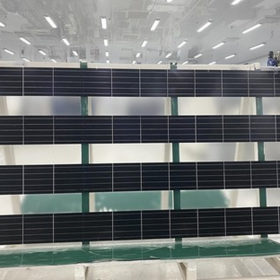
Vietnamese manufacturer Irex has announced a new glass-glass solar panel with a power output of 265 W and a power conversion efficiency of 18.1%.
