South Korea bets on tandem solar technologies
The South Korean government has released a new roadmap to support R&D activities in the solar sector. The document indicates the country’s solar manufacturing industry may be encouraged to opt for high-efficiency and expensive panels based on tandem solar cells.
Organic solar module with 14.4% efficiency
Scientists in China have developed an organic module with an area of 18 cm2 based on a non-fullerene acceptor called DTY6. The device has a certified efficiency of 13.98%, but when a non-halogen solvent was used, it even reached 16.1%.
Scaling up solar manufacturing in India
A new study by the CEEW Centre for Energy Finance assesses China’s advantages over India, but presents ways for the South Asian nation to build a competitive PV manufacturing sector.
New dopants may improve PV glass performance
According to a British-Swedish research team, the down‐shifting process for solar glass manufacturing can be improved through the use of two dopant cations that produce no absorption bands. The doping with these compounds is said to reduce the UV transmission while also keeping the glass free from absorption in the visible and near-infrared ranges.
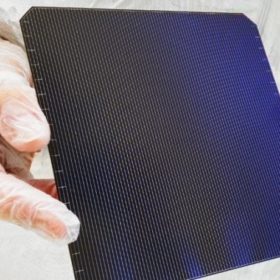
Enel and French PV institute achieved an efficiency of 25.0% for a heterojunction solar cell
The solar cell calibration laboratory ISFH CalTeC has certified the efficiency of the cell, which was made with a standard M2 wafer.

‘Bigger is not always better’
Chinese monocrystalline PV module manufacturer Longi has yet to join the race to produce solar panels with power outputs above 600 W. The decision is line with a clear strategy, a company spokesperson told pv magazine. Outstanding issues for these moduels, according to the manufacturer, include low cell manufacturing yield, system compatibility, concerns about module transport, and hotspot-related failure risks, as well as the need for mechanical loading tests.
Chinese PV Industry Brief: New supply deal for Daqo plus more cell and PV glass production capacity
Chinese polysilicon manufacturer Daqo has secured a long-term supply agreement with PV equipment provider and monocrystalline wafer manufacturer Wuxi Shangji Automation, Shanxi Coal International Energy Group has unveiled a plan to set up a 10 GW heterojunction solar cell production fab and Longi has held its wafer prices.
Daily news round-up: UK reveals details of next renewables auction, Iran’s first floating PV and more hydrogen
Taiwanese cell manufacturer Inventec Solar reportedly halted production this month and Ireland is preparing to remove rooftop solar panel restrictions, according to the Irish Independent.
Manufacturing process for mono cast solar cell exceeding 23% efficiency
Trina Solar has made a PV cell by directly applying the unmodified i-TOPCon process, originally developed for Cz mono wafers, to cast n-type quasi-mono silicon wafers. It claims the average efficiency, tested in-house with a calibrated reference cell, is 22.98%.
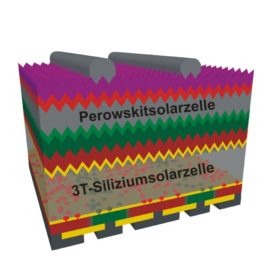
German-led consortium aims for 33% efficient perovskite-silicon solar cell
The Institute for Solar Energy Research Hamelin (ISFH), the Karlsruhe Institute of Technology (KIT) and the Institute for Materials and Components in Electronics at the University of Hannover, as well as Centrotherm, Singulus, Meyer Burger and Von Ardenne are involved in a research project aimed at achieving a 27% conversion efficiency for silicon solar cells based on perovskite.
