
Pacific island nation re-tenders big solar-plus-storage project
An initial tender on Palau was won by French energy company Engie, through its unit Engie Electro Power Systems. The 100 MW microgrid project consisted of coupling 35 MW of solar and 45 MWh of storage with diesel generation.

Slovakian utility ZSE launches virtual battery for residential PV
The service, costing €2 per month, is for residential customers that use PV products provided by the power company. The system is provided by E.ON group – a shareholder in the Slovak utility – and has already been launched in Germany, Czechia and Italy.
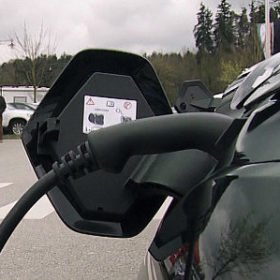
Tesla acquires storage specialist Maxwell Technologies
The target company, which specializes in supercapacitors, will become a wholly-owned subsidiary of Elon Musk’s business.

Massive solar-plus-storage projects move forward in Australia
The Robertstown region could host two big renewable energy projects – a 500 MW solar farm co-located with a 250 MW/1 GWh battery storage capacity, and a construction-ready 200 MW PV project with 120 MWh of storage that forms part of the Solar River Project, the size of which could eventually double.
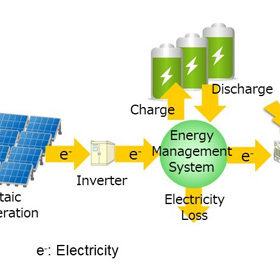
Japanese scientists seek to lower costs of PV-powered hydrogen
A research team has conducted a demonstration of the economic feasibility of battery-assisted, low-cost hydrogen production from solar. The scientists claim their system will mean hydrogen could be produced for $0.15-0.25 per cubic meter in 2030.
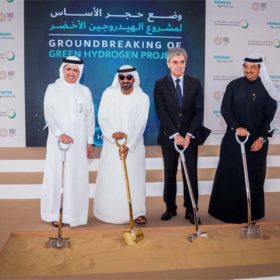
DEWA begins work on hydrogen facility at Rashid Al Maktoum park
Only three months after issuing the project tender, the Dubai Water and Electricity Authority is building the plant with the support of Expo 2020 Dubai and Siemens.
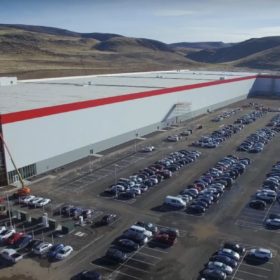
Tesla dives deeper into energy storage, as solar slumps
Elon Musk’s company is seeing tremendous success with its EVs and global manufacturing, as well as dramatically scaling its energy storage deployment. However the Solar Roof is still not being widely deployed.
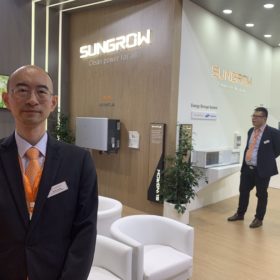
Sungrow on the MENA market: “Of course, the bigger, the better”
Having equipped a three-digit MW volume of large scale and distributed generation projects throughout the region, Sungrow is ready for a rapid regional expansion. EMEA general manager Derek Huang told pv magazine at the World Future Energy Summit about his expectations across all market segments.
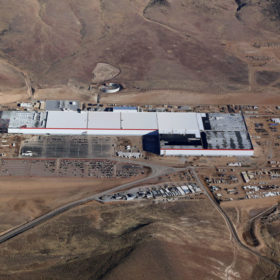
Tesla begins construction of GW factory in China
The US electric car maker wants to start production of its Model 3 in the Chinese factory. Next year, according to high-profile CEO Elon Musk, mass production of electric cars will start there.

US: Top Senate Democrat calls for permanent renewable energy, storage, EV tax credits
U.S. Senator Chuck Schumer is calling for permanent tax credits for clean electricity, storage and EVs as part of a set of demands for the form of any new infrastructure package. What does this mean for solar?
