
Flexible front cover tested for glass-free CIGS devices
Researchers in Japan have developed an effective encapsulation with a PET front cover for copper indium gallium diselenide mini-modules. The lab devices withstood damp heat tests, retaining approximately 97 % of initial efficiency after 3,600 h.
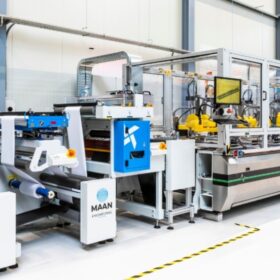
TNO offers mass customization line for integrated PV applications
The Dutch research institute’s highly automated research line offers customized, flexible solar semi-finished PV products to partners developing integrated PV applications.
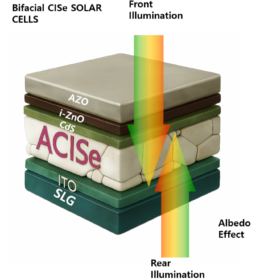
Scientists build bifacial CIS solar cell with record efficiency, power density
Researchers in South Korea have demonstrated a lower temperature process for bifacial copper, indium, selenium (CuInSe₂) solar cells with a rear-side efficiency of 8.44% and 15.30% on the front. The device has been developed for applications in tandem solar cells.
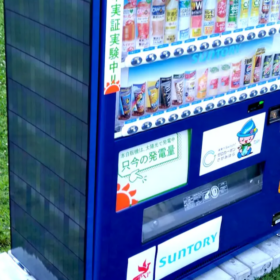
Vending machine trial with chalcopyrite solar
PXP Corp. and Suntory Holdings, both based in Japan, have begun to test the practicality and performance of a vending machine equipped with PXP’s lightweight, glass-free solar panels in Sagamihara, Japan.
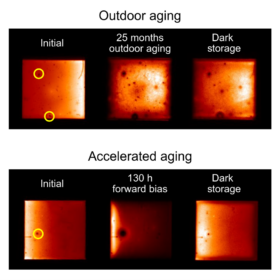
New accelerated aging test for perovskite solar cells
To assess ion migration-induced degradation modes via accelerated ageing of perovskite solar cells, an international research team investiagted using electric forward bias and dark storage approach.
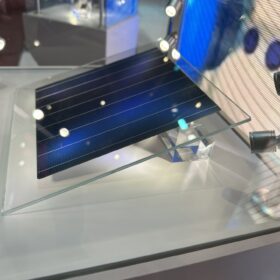
Optimal parameters for perovskite-silicon tandem solar cell manufacturing
Researchers in the Middle East claim to have identified the optimal parameters for the commercial production of perovskite-silicon tandem solar modules across several locations. Their analysis showed that manufacturing costs may currently be as low as $0.387/W, with the prospect of reaching $0.25/W in seven years.

Japanese companies testing chalcopyrite solar panels
Japan-based startup PXP Corporation and JGC Japan Corporation, a unit of JGC Corporation, are collaborating on a 1 kW one-year project to trial lightweight chalcopyrite panels in Yokohama City.

Top cell transparency remains critical challenge for tandem solar cells
New research from Germany has shown how improving top-cell transparency and performance remains key to the commercialization of tandem perovskite-silicon solar cells, as well as for all other types of tandem devices. The analysis demonstrated, in particular, that the top cell must achieve higher single-cell efficiency to compensate for reduced transparency.
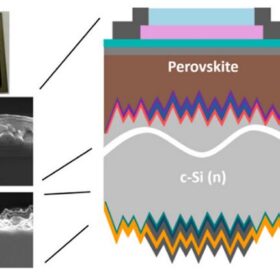
Perovskite-HJT tandem solar cell based on phosphonic acid, self-assembled monolayer achieves 30.22% efficiency
Researchers in Switzerland have fabricated a perovskite-silicon tandem solar cells that utilizes a heterojunction cell as bottom device. The cell is said to circumvent the film formation issue associated with the use of phosphonic acid and achieve high efficiency levels.
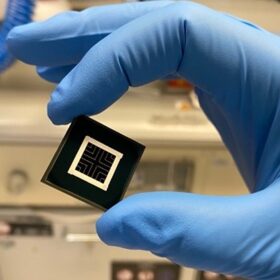
Fraunhofer ISE concludes perovskite-silicon tandem solar cell project
The five-year MaNiTU project, involving six Fraunhofer institutes, covered a range of investigations across the life cycle of perovskite-silicon tandem solar cells. It included the development of a scalable solar cell with a 31.6% power conversion efficiency.
