
Self-cleaning perovskite solar cell based on leek leaves-like film achieves 14.2% efficiency
Scientists in Finland have built a perovskite solar cell with a bio-inspired coating that reportedly improves light transmittance while providing self-cleaning properties. The film was able to improve the device efficiency by up to 6%.
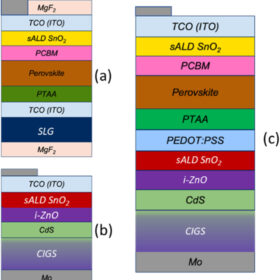
Two-terminal perovskite-CIGS tandem solar cells have technical potential to achieve 26.69% efficiency
A Dutch and U.S. research team performed optical and electrical simulations to understand loss mechanisms in two terminal (2T) tandem cells based on perovskite and commercially available copper-indium-gallium-selenide (CIGS) cells, and subsequently established a roadmap to increase efficiency via four key modifications.
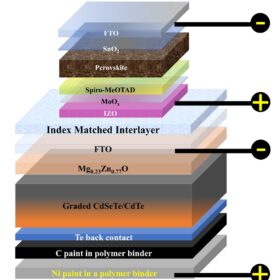
Perovskite-cadmium telluride tandem solar cell based on special electrode achieves 24.2% efficiency
An Indian-US research team has fabricated a four-terminal perovskite-cadmium telluride tandem solar cell by utilizing a highly conductive and sputtered transparent electrode to increase the current density of the bottom cell. The tandem device combines a 18.3%-efficient top perovskite cell and a 19.53%-efficient cadmium telluride bottom device.
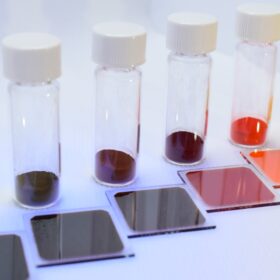
New vapor deposition tech could accelerate commercialization of perovskite solar cells
A U.S.-based team developed a vapor deposition technique to fabricate outperforming all-inorganic perovskite thin films in under 5 minutes in a continuous process. The adoption of the proposed approach may also result in higher perovskite solar cell power conversion efficiencies.
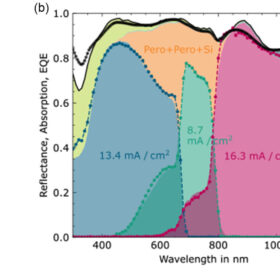
Perovskite-perovskite-silicon triple-junction solar cells have technical potential to reach 44.3% efficiency
A German research team has investigated the optical properties of perovskite/perovskite/silicon triple-junction cells and has found these devices may have a practical efficiency potential of 44.3% assuming idealized electrical parameters. These cells may also potentially achieve a fill factor of 90.1%.
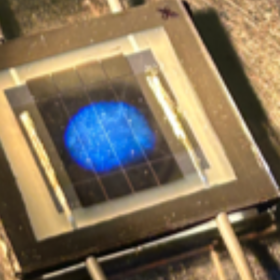
New roadmap identifies critical priorities for commercialization of tandem solar cells
NREL researchers reviewed and assessed a variety of tandem solar cell pairings on technology status and prospects. Their work is intended to identify what kind of work lies ahead on the path to commercialization.
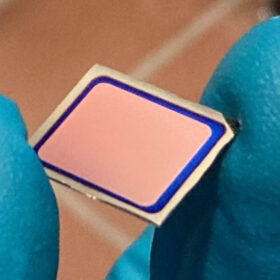
First attempt to build selenium-silicon tandem solar cells
Scientists in Denmark attempted for the first time to build a selenium-silicon tandem solar cell and found the device was immediately able to deliver a remarkable open-circuit voltage. Despite its current low efficiency levels, the new cell concept promises to reach efficiencies over 40%, according to its creators.
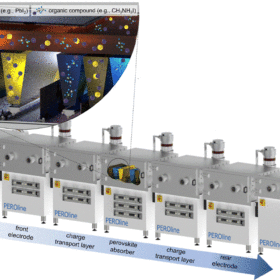
Vapor-based deposition key to commercialize perovskite solar
Researchers from ten countries assessed the prospects of using vapor-based deposition processes to put perovskite thin film processing on the fast track to commercialization, drawing attention to its merits and key areas to research and develop.
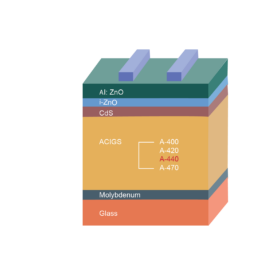
Silver-alloyed CIGS solar cell achieves 17.7% efficiency
Developed by scientists in Korea, the so-called ACIGS cell is intended for applications in perovskite-CIGS tandem PV devices. Their work demonstrates correlations between element diffusion behavior and notch-point formation in ACIGS films.

Fraunhofer ISE creates way to assess perovskite-silicon tandem PV modules
Fraunhofer ISE is leading a project that is developing methods to characterize perovskite-based tandem modules, in an effort to facilitate their industrial implementation. A specially built Wavelabs solar simulator is now being used at the institute’s CalLab PV Modules.
