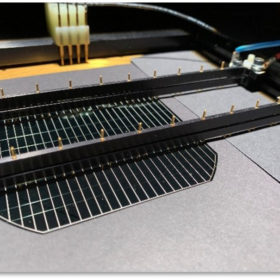
Modular systems to produce perovskite-silicon cells on six-inch wafers
Researchers in Germany are scaling up efforts to bring perovskite-silicon tandem solar cell technology into industrial scale production. The scientists say manufacturing cells of that kind is possible on widely-available six-inch silicon wafers and modular systems are being designed to do so at scale.
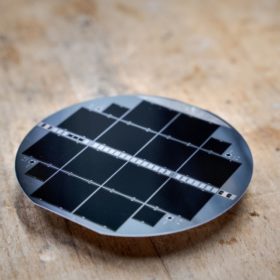
Fraunhofer ISE claims 25.9% efficiency for III-V tandem solar cell
The new results mark an improvement on the institute’s previous 24.3% efficiency record. The III-V tandem solar cell is directly grown on silicon.
Tandem solar modules vs commercial crystalline
Researchers in France have tried to predict the competitiveness of tandem PV modules against commercial crystalline products in 2030. Crystalline products will be 22-24% efficient in a decade, according to the researchers, possibly 25% if interdigitated back-contact heterojunction versions become mainstream. To compete, tandem devices will need to offer similar life spans and degradation rates, plus efficiencies of 30%.
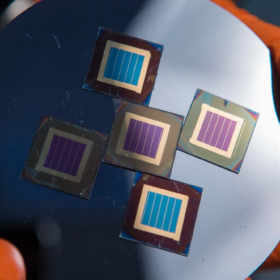
Australian researchers push boundaries on tandem solar cells
Scientists at Australian National University have achieved a 27.7% efficiency rate for mechanically stacked perovskite-silicon tandem cells.

A perovksite-silicon tandem cell with 25.7% efficiency
The device exhibited a small performance loss after a 400-hour thermal stability test at 85 degrees Celsius and after the same period under maximum power point tracking at 40 degrees Celsius, according to its developer. The cell was made by combining solution-processed, micrometer-thick perovskite top cells with fully-textured silicon heterojunction bottom cells.
