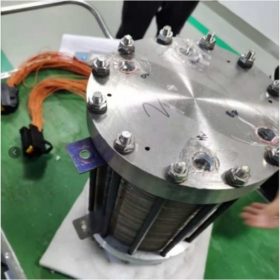
PEM electrolysis coupled with thermal energy storage
Chinese researchers claim to have improved the performance of a proton exchange membrane electrolyzer by connecting it to a thermal energy storage system.

Hybrid thermionic-photovoltaic converter for applications in thermal energy storage, waste heat recovery
A Spanish-Italian research group has developed a solid-state thermal-to-electric energy converter based on hybrid thermionic-photovoltaics (TIPV) for different applications. It consists of a three-terminal TIPV device made with a tungsten (W) thermionic cathode, a PV/anode structure made of an indium phosphide (n-InP) anode, and a photovoltaic cell based on indium gallium arsenide (InGaAs).
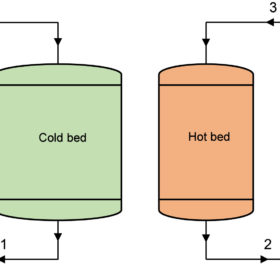
Storing renewables with Brayton pumped thermal energy storage
UK researchers have designed a pumped thermal energy storage system for large-scale grid electricity, stored as high-grade thermal energy. It is based on a Brayton PTES concept demonstrated by Isentropic Inc., and consists of two insulated containers filled with gravel, and hot and cold vessels operating at different pressure levels.

Thermochemical storage-plus-rooftop PV to store heat for winter months
A group of researchers in the United Kingdom is developing a modular, multi-vector energy system that can be installed into new homes and retrofitted into existing buildings to provide seasonal heat storage. In the proposed system configuration, a rooftop solar array would be used to power a heat pump or another electrical heating element, which in turn produces the heat to be stored by thermal devices.
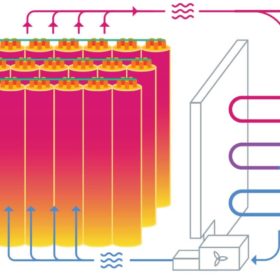
Renewable energy heat batteries for industrial applications
Startup Rondo Energy closed a $22 million Series A funding round to decarbonize industrial processes with equipment that converts solar and wind energy into thermal energy.
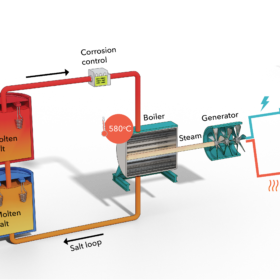
Storing solar power with grid-scale molten hydroxide
Seaborg Technologies, a Danish manufacturer of molten salt nuclear reactors, has turned a technology that was originally developed for nuclear power into a large-scale storage solution for wind and solar. It has developed a storage system that uses renewable energy to heat salt with electrical heaters, based on two-tank molten salt storage designs developed for concentrated solar power plants.

Long-duration thermal storage system based on silica sand
Developed by Italian dry bottom ash handling system provider Magaldi Power, the system produces green thermal energy — steam or hot air — which can be used directly in industrial plants or for the generation of electricity using steam turbines. The system consists of a blower, a fluidization air blowing system, a fluidization air suction system, an air filter and fan, an air pre-heater, and an integrated thermal energy storage module. Silica sands are the system’s storage media.
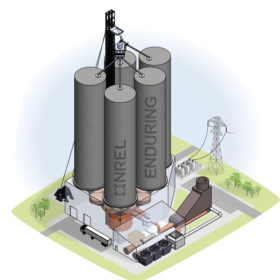
Storing wind, solar power with silica sands
NREL researchers developed a system that uses heated silica particles for thermal energy storage. The baseline technology is designed for a storage capacity of up to 26,000 MWh and is claimed to have a cost of of between $2 and $4 per kWh.

‘Water battery’ a winner for Australian university
In the first year of operation, the thermal energy storage tank saved 4,232 tonnes of CO2 emissions – with 3,082 tonnes saved by the University of the Sunshine Coast through using solar power instead of grid electricity, and the rest by feeding solar energy into the grid.

Aluminum energy storage coming to Abu Dhabi
Swedish start-up Azelio says it will have a pilot project up and running in Masdar City by the end of next month. The technology sees electricity used to super heat aluminum with energy released on demand via a heat transfer fluid to drive a Stirling engine.
