2035: The renewable energy tipping point

In a new report on the global energy transition, Thinking global energy transitions: The what, if, how and when, Wood Mackenzie, which recently acquired GTM Research, posits that 2035 will mark the “point of singularity”, when the world moves away from oil and gas to enter the age of renewables.
For the analysts, the global energy transition (GET) will be complete when the new technologies achieve a 20% market share, or account for 50% of new development or sales activity.
The growing sustainability movement is helping with such changes as decarbonization goals, green investments and corporate social responsibility, says Wood Mackenzie, adding that smart cities are also helping to drive technological progress. It estimates that around 1,000 such cities are in the planning, with 300 located in China alone.
However, it is renewables and electric-based technologies that are the two key factors driving the GET, the analysts say; something the Intergovernmental Panel on Climate Change (IPCC) and Finland’s Lappeenranta University of Technology also recently highlighted, in two separate reports.
Indeed, stating that there is “no alternative to a world of 100% renewables,” Christian Breyer, Professor of Solar Economy at the Lappeenranta University of Technology told pv magazine in an interview yesterday that the energy transition “is not only a matter of survival, it is also the cheapest way to shape our energy future, as solar and renewables have the potential to reduce the LCOE of global power supply from €70 [$80.91]/MWh in 2015 to between 50 and €55/MWh by 2050…”
He continued, “The easiest part of this trajectory will be the switch to renewables of the power sector, while the hard job will have to be done for the transport, industry and chemical sectors.”
Convergence
While renewables growth is far beyond that of electrification, “By 2035, the convergence of the two will usher in the age of renewables,” proclaims Wood Mackenzie, adding that “sustainably-friendly” technologies like autonomous driving and machine learning applications will become the norm.
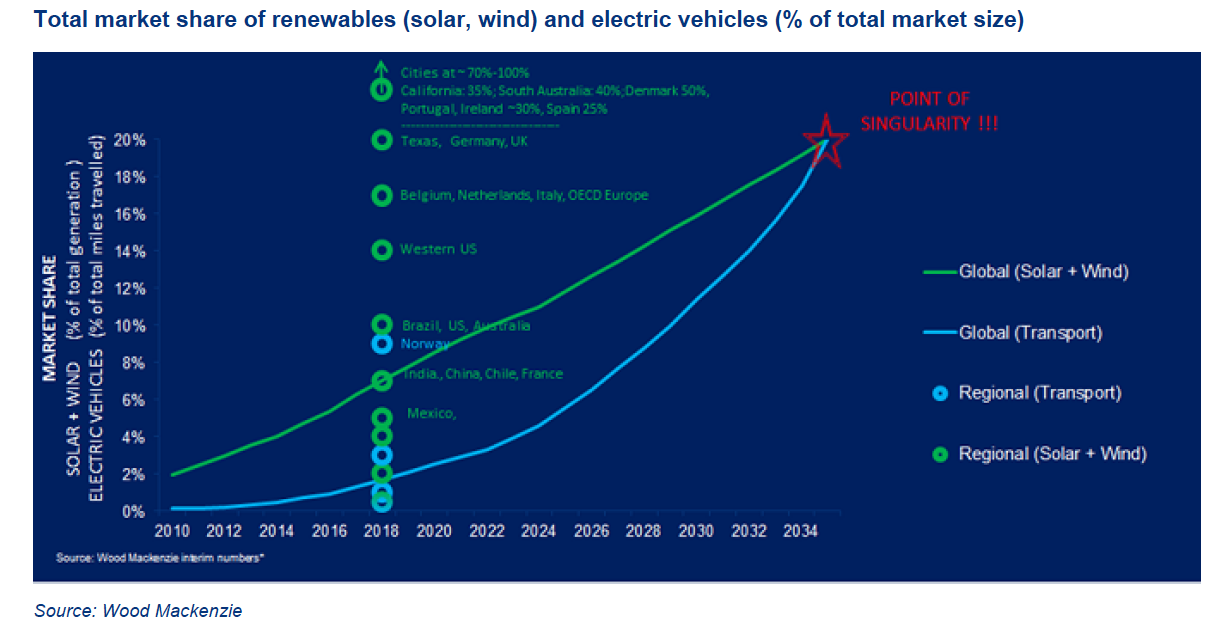
By this time, close to 20% of global power needs will be met by solar or wind, they predict, while up to 20% of all miles traveled by cars, trucks, buses and bikes will have electric motors. Furthermore, by 2036, oil demand is expected to peak, with oil demand displaced from electric vehicles (EVs) doubling to almost six million barrels daily, by 2040.
Currently, says Wood Mackenzie, the power and transport sectors account for 70% of global coal demand, 50% of global oil demand and upwards of 30% of global gas demand.
In an interview with pv magazine in August, founder and CEO of The Mobility House, Thomas Raffeiner talked about how EVs are already helping to transform electricity grids with the help of bidirectional inverters, which allow for not only grid-to-vehicle charging, but also vehicle-to-grid, and vehicle-to-vehicle charging. He also believes that “very soon … it is only going to be wealthy people who drive combustion engines. Most people simply won’t be able to afford a combustion engine anymore.”
Post singularity
After 2035, the world can expected to see the adoption rates for both renewables and electrified transport “rapidly” increasing, “becoming the default choice across many energy systems around the world.”
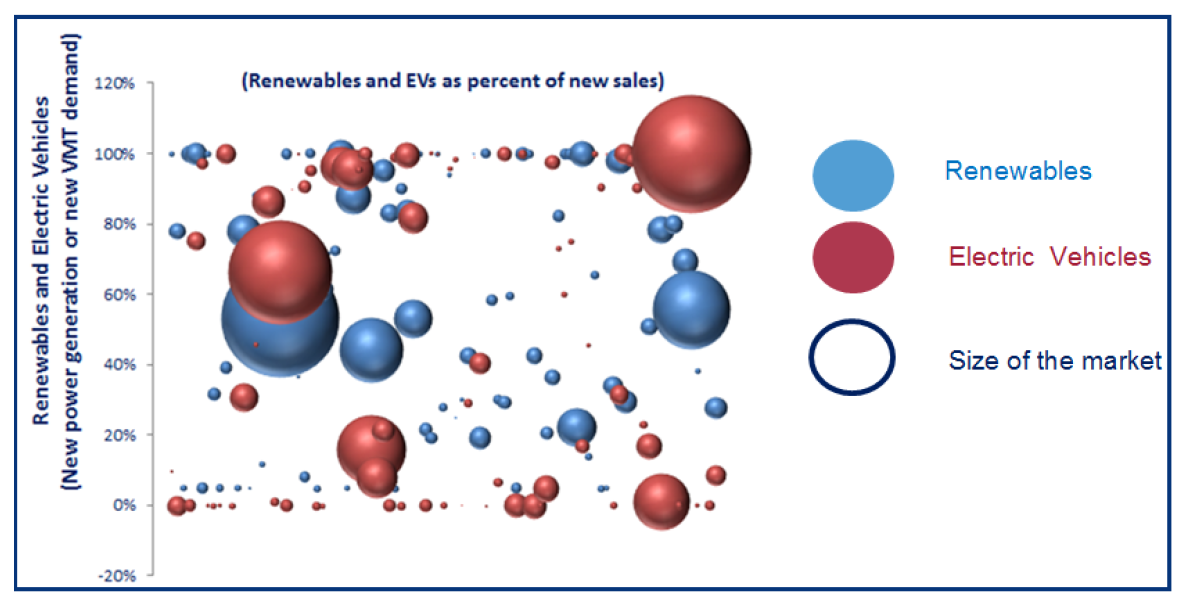
Image: Wood Mackenzie
Wood Mackenzie further predicts that half of all new power plants built after 2035, globally, will comprise either solar, wind, or a hybrid combination with storage; while EVs will account for half of all additional road miles travelled. “The convergence of other technologies embedded within grid-edge applications – autonomous and shared driving, for instance – facilitate this rapid uptick,” they say.
The transition to the age of renewables could be increased by such factors as increasing cost competitiveness, technical breakthroughs in batteries and storage, and forward thinking policies. Challenges to the GET do remain, however, including the possibility that battery prices do not come down as fast as anticipated, low consumer acceptance of EVs, a lack of adequate charging infrastructure and, of course, unsupportive policies.
“The next 15 years of the transition will be critical to study, prepare and plan,” Prajit Ghosh, Wood Mackenzie’s head of global strategy, power & renewables says. “To prosper in the new energy reality, companies and investors will need to understand the future opportunities across the rapidly changing energy landscape, while remaining in touch with the evolving oil, power and metals markets.”
Is it enough?
Last week, the Intergovernmental Panel on Climate Change (IPCC) released a new report on different ways global warming can be kept within the 1.5°C limit. Their key finding was that unprecedented changes in all aspects of society are needed, very rapidly and at a large-scale.
Until 2035, the world will need to invest US$2.4 trillion between 2016 and 2035 for the transition of the industrial, energy, agricultural, residential and transport sectors, the authors found – equivalent to 2.5% of global GDP; while global human-caused carbon emissions will need to decrease by 45% from 2010 levels, by 2030, to reach “net-zero” by 2050.
Meanwhile, in yesterday’s interview, Christian Breyer said, “A world energy system based exclusively on renewable energies and an almost fully electrified world are our only chances to avoid further disasters. This is absolutely doable, and at lower costs than today.”
As such, while Wood Mackenzie’s news is positive, will the GET it forsees be enough to drive the changes necessary, in the required time period, to avoid further catastrophic changes to our global climate?
This content is protected by copyright and may not be reused. If you want to cooperate with us and would like to reuse some of our content, please contact: [email protected].

Please login to comment

[…] from institutional investors for renewable energy generation capacity is likely to rise $210 billion over the next five years, with utility-scale PV capturing a 43% […]
[…] de investidores institucionais para a capacidade de geração de energia renovável deve subir US $ 210 bilhões nos próximos cinco anos, com a captação de energia em escala […]
[…] How will we know the tipping point has arrived? Wood Mackenzie’s analysts say the global energy transition will be complete when the new technologies achieve a 20% market share or account for 50% of new development or sales activity, according to PV Magazine. […]
[…] How will we know the tipping point has arrived? Wood Mackenzie’s analysts say the global energy transition will be complete when the new technologies achieve a 20% market share or account for 50% of new development or sales activity, according to PV Magazine. […]

Deep inside the IPCC Special UN report said that less than 2% of the 529 calculated scenarios could keep warming below the 1.5 deg C goal – – – so, basically no chance of parking climate at 1.5 deg C. Further, the greatest tipping point will probably be the Arctic blue water event within the next few years that could release a permafrost, methane burst of 50 Gigatons that could push global warming to 2.0 deg C by 2030 (see Prof. Peter Wadhams work). Sadly this report is still too conservative. Within 5 years the globe needs to have manufacturing capacity of 1 Trillion watts / year of solar/wind costing roughly $1 trillion / year (Central banks printed $17 trillion in 2008, so , the money is available). Additionally, individual car ownership for large cities have to be replaced by Transportation as a Service using self-driving, Uber like ride sharing and EV’s. This is the only way to get to 45% GHG emission reductions by 2030. And, this only gives us a chance of rolling over the an ecological civilization.
[…] this new economy will be driven by private industry and market forces. And once an economic sector reaches that tipping point, change is disruptive and happens […]