Six-junction III–V solar cell with 47.1% efficiency

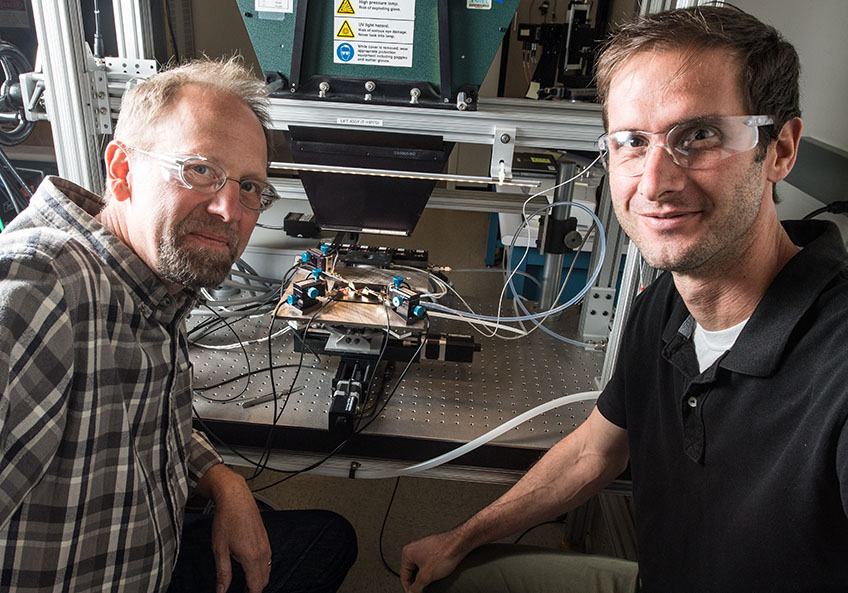
Researchers from the U.S. Department of Energy’s National Renewable Energy Laboratory (NREL) have developed a six-junction III–V solar cell with a 47.1% conversion efficiency rate under 143 Suns concentration.
They said that they have achieved an efficiency rate of 39.2% under one-sun illumination. The cell is based on six different photoactive layers fabricated with alloys of III–V semiconductors, which can each capture light from a specific part of the solar spectrum.
“The device contains about 140 total layers of various III-V materials to support the performance of these junctions, and yet is three times narrower than a human hair,” the scientists said.
The cell could be used in concentrator photovoltaics and has the potential to reach a 50% efficiency rate, they added. However, resistive barriers inside the cell impede the flow of current, which is the main obstacle to achieving the 50% target, they acknowledged in Six-junction III-V solar cells with 47.1% conversion efficiency under 143 suns concentration, which was published in Nature Energy this week.
In June, other NREL researchers – in partnership with scientists from the Korea Advanced Institute of Science and Technology – demonstrated a way to produce gallium arsenide (GaAs) solar cells with a reusable germanium substrate. NREL has also worked with Chicago-based Microlink Devices in the past to produce a three-junction cell with a record-setting 37.75% conversion efficiency rate.
The cost of producing solar cells based on compounds of III-V element materials – named according to the groups of the periodic table they belong to – has thus far limited such technologies to niche applications, including drones and satellites, where low weight and high efficiency are more pressing concerns than cost.
This content is protected by copyright and may not be reused. If you want to cooperate with us and would like to reuse some of our content, please contact: [email protected].

Please login to comment

[…] materials (with target efficiency of >30%) and hybrid tandem III-V/Si solar cells. Their six-junction III-V solar cells have reached an efficiency of 47.1% under concentrated light. Moreover, Si-based bifacial […]
[…] Nguồn tin : Tạp chí pv-magazine.com […]
[…] materials (with target efficiency of >30%) and hybrid tandem III-V/Si solar cells. Their six-junction III-V solar cells have reached an efficiency of 47.1% under concentrated light. Moreover, Si-based bifacial […]
[…] six-junction solar cell now holds the world record for the highest solar conversion efficiency at 47.1%, which was measured […]

Omg thank you John and Ryan this is Amazing 47.1% God. This is beyond amazing can’t wait for it to be on the market. This gone change the whole industry amazing work can’t wait to put it on the roof. This basically gone take half the space double the production. All those houses disqualified because of the roof space will be able to go solar this is amazing work. Thank you thank you thank you. Can’t wait for production.

Interested to learn if this Six-Junction III solar cell is cheaper than 3PV of Prof.Dr.A.Hubler of the Chemnitz University……..also, does it mean than this Six-Junction III solar cell is the practícal achievement of the theorotical invention of the Prof.Dr.j.Grossman at the MIT ten yesos ago?

It’s very useful 😊

I have been doing electronics design using an old style 9V solar cell for power and form factor bread-boarding, then saw the new 6V 25% efficient SK cells on sale so we scaled to bench prototype around those but something wasn’t working, until we did a scaled test under load from 0% sun to 100%, and found these 25% cells have a flat 4V response with a 6V peak at 100%, but under any load at all, they drop out. So they’re basically worthless for power applications and limited to just for like a p’resistor-and-LED triggering circuit.

Very nice invention more power less panel.ty

The cost of Multi-junction cells are too high. Any manufacturing process to reduce their cost by a factor would be a great accomplishment. Then they can become mainstream.

Really if greener world is what the developed countries are trying to achieve,such researches like this must be released for commercial production
[…] To Read More, Please Visit Source […]
[…] by the U.S. Department of Energy’s National Renewable Energy Laboratory (NREL) recently garnered 47% efficiency ratings in the lab and 40% in a real world setting. But, photovoltaic technology will likely never […]