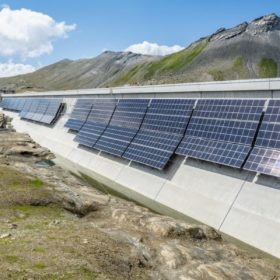
Alpine vs. urban solar
A group of Swiss researchers has shown that optimized alpine PV installations could offer revenues that are on average 20% higher than those of standard, urban, installations. Furthermore, they found that the Swiss Alps have the potential to host about 1 GW of solar capacity offering revenues 33% higher.
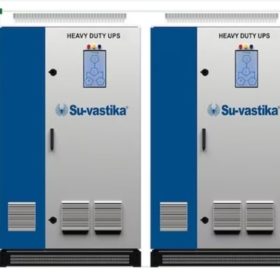
Indian startup launches solar-linkable UPS system for residential, commercial applications
Su-vastika introduced a three-phase uninterruptible power supply (UPS) system with power ratings of 10 kVA to 500 kVA. The backup time provided by the system can be extended by using solar power in conjunction with the battery bank.
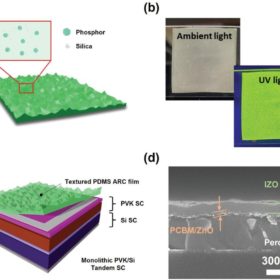
Tandem perovskite-silicon solar cell achieves 23.5% efficiency via novel anti-reflective coating
Korean scientists utilized an anti-reflective coating based on silicon dioxide (SiO2) nanoparticles and large phosphor particles to increase diffuse light transmittance in a tandem perovskite-silicon PV device. The device’s efficiency improved from 22.48% to 23.50%.
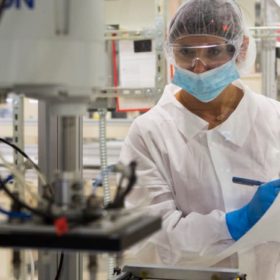
OCI raises capacity of US solar panel factory from 210 MW to 1 GW
OCI said its US unit, Mission Solar Energy, would begin production of M10 PV panels at its Texas manufacturing facility in 2023.

Netherlands may add 3.3 GW of new solar this year
According to state-run agency RVO, solar may reach 17.6 GW of installed capacity by year-end, thus becoming able to cover more than 12% of the country’s electricity demand.
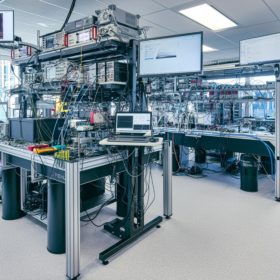
The mobility rEVolution: Volkswagen taps quantum computing for battery research
Foxconn is looking to leverage its manufacturing expertise and become a major EV maker, Rolls-Royce has unveiled its first fully electric motor car, and BMW has pledged to invest $1.7 billion to build EVs in the U.S..
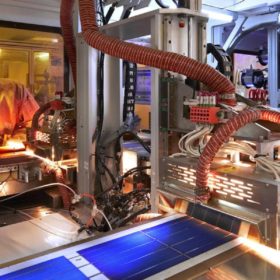
China’s solar cell production capacity may reach 600 GW by year-end
The Asia Europe Clean Energy (Solar) Advisory revealed that most of the planned new solar cell production capacity relates to high-efficiency n-type cell technologies such as TOPCon and HJT.
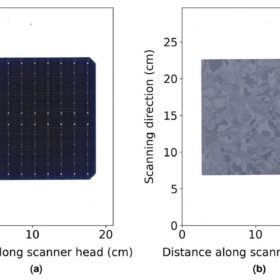
Determining solar cells’ optical properties with conventional flatbed office scanners
Australian researchers have sought to measure solar cells’ optical properties via low cost office scanners and found they may offer results that are comparable to those of tools used in the PV industry.
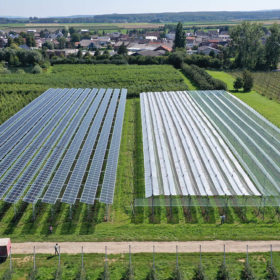
It’s time to bin the false agriculture vs solar debate
With the last incumbent to enter and leave the revolving door of UK prime ministers having caused alarm by reportedly preparing plans to effectively ban big solar on farmland, Harald Överholm, CEO of clean energy company Alight, says politicians need to put discredited arguments behind them and get on with the urgent business of shoring up energy security.
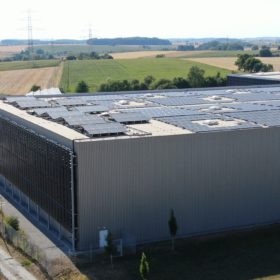
Polypropylene absorber to simplify brine heat pumps’ adoption
German company Mefa Befestigungs- und Montagetechnik has developed absorbers made of polypropylene that are intended to simplify the use of brine heat pumps. The novel technology should make it possible to combine multiple heat sources, including water, earth, air and also ice storage all within a single system.
