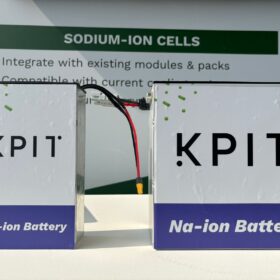
KPIT unveils sodium-ion battery with energy density of up to 170 Wh/kg
KPIT, an India-based automotive software and engineering solutions supplier, has unveiled its proprietary sodium-ion battery technology, and is now on the lookout for manufacturing partners. Ravi Pandit, chairman of KPIT, tells pv magazine, that that the company has developed multiple variants with energy density ranging from 100 Wh/kg to 170 Wh/kg, and potentially reaching 220 Wh/kg.
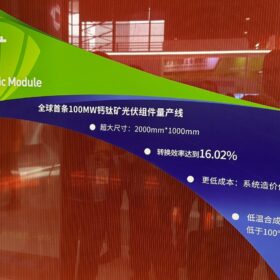
Chinese PV Industry Brief: GCL Group plans 2 GW perovskite PV panel factory
GCL Group has announced plans to build China’s first gigawatt-scale perovskite solar module factory in Suzhou, Jiangsu province. It said in November that its 1 m x 2 m perovskite single-junction modules had reached a power conversion efficiency of 18.04%.

South Africa explores ‘white’ hydrogen potential
A handful of projects are now exploring for “natural” hydrogen, also known as “white” hydrogen. pv magazine speaks with Adam Bumby, associate professor of structural geology at the University of Pretoria, about the HyAfrica project and the geological strata and structures that are most suitable for hydrogen storage.
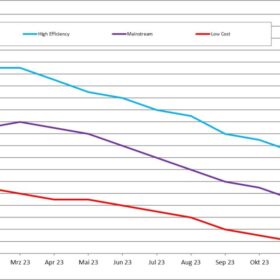
Renaissance of mass solar production in Europe postponed
As solar module prices continue to fall, pvXchange.com founder Martin Schachinger explains the difficulties of rebuilding a solar supply chain from scratch in Europe.
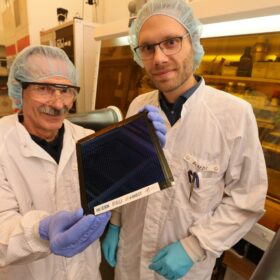
German researchers claim record-breaking 14.46% efficiency for organic PV module
A team of scientists at Germany’s Friedrich-Alexander Universität Erlangen Nürnberg has set an efficiency record of 14.46% for an organic PV module. The performance was certified by Germany’s Fraunhofer Institue for Solar Energy’s PV calibration laboratory (CalLab).

Octopus Energy Group receives $800 million investment
British renewable energy company Octopus Energy Group announced it would use a recent $800 million investment to “drive real scale” of heat pump manufacture and installation, and create 3,000 new jobs.

ACWA Power signs 442 MW solar project PPA with Eskom
Saudi Arabia-based energy developer ACWA Power says it has signed a power purchase agreement (PPA) with state-owned utility Eskom for a 442 MW solar facility with 1200 MWh of battery storage in South Africa’s Northern Cape province.
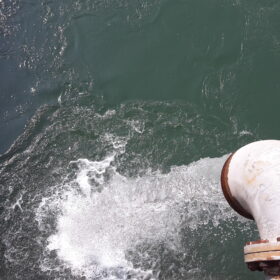
Green hydrogen and its water use problem
The climate crisis threatens water management and the water crisis in Montevideo, Uruguay, in 2023 illustrates the damage new industrial projects could cause if not thoroughly assessed. With green hydrogen projects gaining international prominence, it is vital they are properly planned.
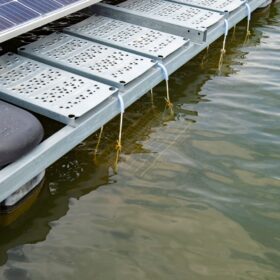
Floating solar positively affects aquatic environments, says BayWa re
German renewable energy developer BayWa re has collected scientific data on aquatic fauna, water quality, and avifauna from several environmental impact monitoring studies on eight of its operational floating PV facilities in Europe. It has found the artificial habitats under the panels offer protection to some animal species and improvements to water quality.
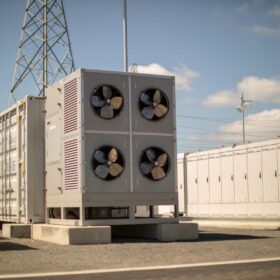
Australian state allocates 350 MW of solar, 4,000 MWh of storage in tender
Five energy infrastructure projects representing 750 MW of renewable energy generation and 524 MW/4,192 MWh of long-duration storage have been successful to the New South Wales government’s latest tender round, as it prepares for the exit of coal-fired power generation from the Australian state’s electricity grid.
