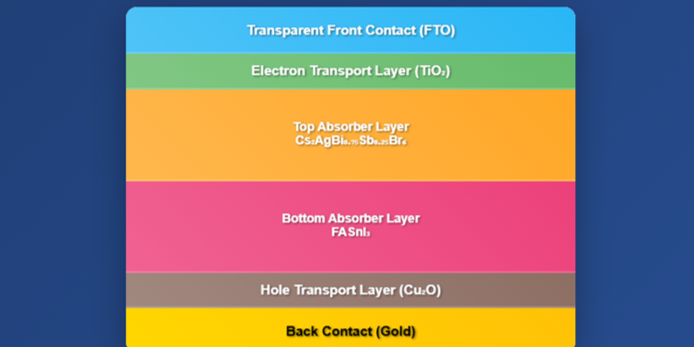





Researchers at the University of Babylon in Iraq have simulated a novel two-terminal (2T) lead-free all-perovskite tandem solar cell with a wide bandgap antimony-doped perovskite top subcell and a narrow bandgap formamidinium tin iodide bottom subcell, finding a potential power conversion efficiency of 28.22%.
“Our research involved the numerical simulation of a novel, two-terminal (2T) all-perovskite lead-free tandem solar cell using the SCAPS-1D (Solar Cell Capacitance Simulator) software,” Ghaleb Ali Al-Dahash, corresponding author of the research, told pv magazine.
The proposed tandem features a wide bandgap antimony-doped Cs2AgBiBr6, specifically Cs2AgBi0.75Sb0.25Br6, top cell and a narrow bandgap formamidinium tin iodide (FASnI3) bottom device.
The novelty of the work lies in the use of two under-explored lead-free perovskite materials, selected specifically to address well-known stability issues in lead-free perovskites, and to provide high-efficiency power conversion, according to Al-Dahash.
“Double perovskites like Cs2AgBiBr6 are known to be inherently more stable against moisture and heat compared to many lead-halide perovskites,” said Al-Dahash, adding that although FASnI3 has known stability issues “related to the oxidation of tin,” they were not evident when the cell was integrated into a tandem structure with a stable, wide bandgap top cell.
“Our simulations show that this lead-free design has the potential to reach a power conversion efficiency of 28.22%, which is a significant advancement for environmentally friendly photovoltaics and rivals the performance of some lead-based counterparts,” said Al-Dahash.
The efficiency was achieved under standard illumination conditions. The tandem cell also reached a fill factor of 88.74 %, with a short-circuit current density of 27.886 mA/cm2, and an open-circuit voltage of 1.1402 V.
Its optimized structure was as follows: transparent fluorine-doped tin oxide (FTO) front contact, titanium oxide (TiO2) electron transport layer, perovskite absorber (Cs2AgBi0.75Sb0.25Br6), formamidinium tin iodide (FASnI3) perovskite absorber, copper(I) oxide (Cu2O) hole transport layer, and gold back contact.
When comparing the work with previously reported results, the researchers said that their optimized cell competed well on overall efficiency. “This shows how well our layered material system and Cu2O hole-transport layer work,” they said.
Their work is described in High-efficiency lead-free all-perovskite tandem solar cells achieving 28.22 % power conversion efficiency: A Cs2AgBi0.75Sb0.25Br6/FASnI3 heterostructure design, published in Results in Optics.
“The study provides an optimized pathway for creating scalable, high-performance, and non-toxic tandem solar cells,” stated Al-Dahash.
The research team is currently designing a new tandem all-perovskite device with a higher efficiency target, according to Al-Dahash.
This content is protected by copyright and may not be reused. If you want to cooperate with us and would like to reuse some of our content, please contact: editors@pv-magazine.com.

By submitting this form you agree to pv magazine using your data for the purposes of publishing your comment.
Your personal data will only be disclosed or otherwise transmitted to third parties for the purposes of spam filtering or if this is necessary for technical maintenance of the website. Any other transfer to third parties will not take place unless this is justified on the basis of applicable data protection regulations or if pv magazine is legally obliged to do so.
You may revoke this consent at any time with effect for the future, in which case your personal data will be deleted immediately. Otherwise, your data will be deleted if pv magazine has processed your request or the purpose of data storage is fulfilled.
Further information on data privacy can be found in our Data Protection Policy.