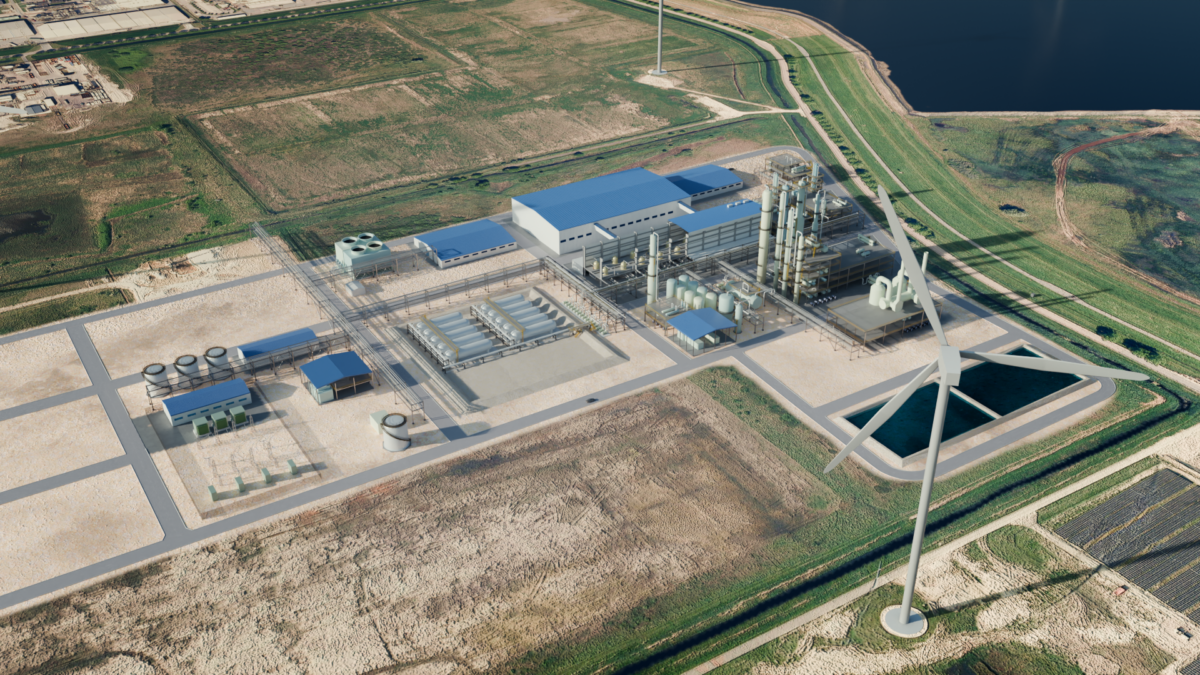





Dutch startup Resilicon has made a step towards developing Europe’s first polysilicon plant powered by renewable energy.
Resilicon has secured American silicon specialists Advanced Material Solutions (AMS) as its technology provider and US-based engineering and construction firm Fluor as its engineering partner, which it says paves the way for the project’s basic engineering phase to commence.
This phase of the project is backed by over €14 million ($16.3 million) in funding with contributions from the Dutch Ministry of Economic Affairs and Resilicon’s technical partners, among others.
According to details on Resilicon’s website, the company secured exclusive rights to AMS’ technology in Europe, the Middle East and Africa. The technology is already deployed successfully in South Korea and India and has been demonstrated to cut energy consumption in polysilicon production by up to 30%.-
Resilicon says it is now preparing for the next phase of development and financing, including permitting, detailed design and stakeholder engagement.
The polysilicon plant is set to be located in the city of Delfzijl, within the Groningen Sea Ports area of northeastern Netherlands. Once completed, it will produce high-purity polysilicon at scale for solar, semiconductors and battery supply chains, while being fully powered by renewable energy.
Resilicon estimates a total €900 million (around $1.04 billion) in financing is required for the project and has revealed several parties are exploring the investment opportunity under the guidance of KPMG.
European demand for polysilicon, the foundational component of solar cells, is projected to rise between 80,000 to 120,000 MT by the end of the decade, equivalent to at least four world-scale polysilicon production facilities, Resilicon says. Over 85% of polysilicon production globally is currently concentrated in China.
Gosse Boxhoorn, Resilicon founder, commented that polysilicon is a key critical raw material to reduce Europe´s dependence on China. “Securing its supply is essential for the future of Europe’s key industries, including the energy sector, automotive, electronics, and defence,” Boxhoorn added.
In August, it was reported that China’s six largest polysilicon manufacturers plan to raise around $7 billion to buy and idle roughly one-third of the country’s polysilicon production capacity. Earlier this year, researchers warned the Chinese polysilicon industry could trigger a global polysilicon shortage by 2028 if too much production capacity is cut.
This content is protected by copyright and may not be reused. If you want to cooperate with us and would like to reuse some of our content, please contact: editors@pv-magazine.com.


By submitting this form you agree to pv magazine using your data for the purposes of publishing your comment.
Your personal data will only be disclosed or otherwise transmitted to third parties for the purposes of spam filtering or if this is necessary for technical maintenance of the website. Any other transfer to third parties will not take place unless this is justified on the basis of applicable data protection regulations or if pv magazine is legally obliged to do so.
You may revoke this consent at any time with effect for the future, in which case your personal data will be deleted immediately. Otherwise, your data will be deleted if pv magazine has processed your request or the purpose of data storage is fulfilled.
Further information on data privacy can be found in our Data Protection Policy.