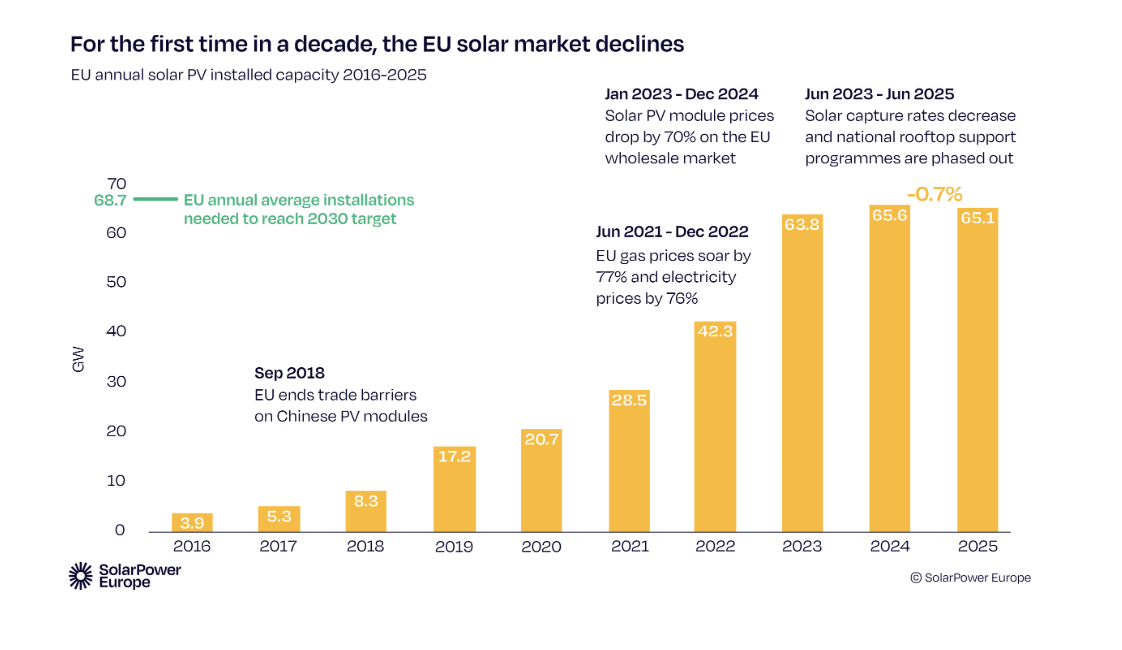





The European Union deployed 65.1 GW of solar this year, according to SolarPower Europe’s EU Solar Market Outlook 2025-2030.
The figure is a 0.7% decrease on the 65.6 GW installed in 2024, the report says, making 2025 the first year since 2016 when less solar was added than the year before.
The bloc’s total solar fleet now stands at 406 GW, ahead of the 400 GW target set for the end of this year by the 2022 EU Solar Strategy.
However, SolarPower Europe is warning that the EU is falling off the pace of achieving the strategy’s 750 GW target for 2030, with two further years of market decline expected.
Based on the association’s medium scenario, total solar installations are expected to drop beneath 62 GW in 2026 and to little under 60 GW in 2027. Year-on-year installations are then expected to begin climbing again, driven by storage, flexibility, electrification and improvement in framework conditions, but are only forecast to surpass this year’s result in 2030, when the medium scenario expects almost 68 GW to be added.
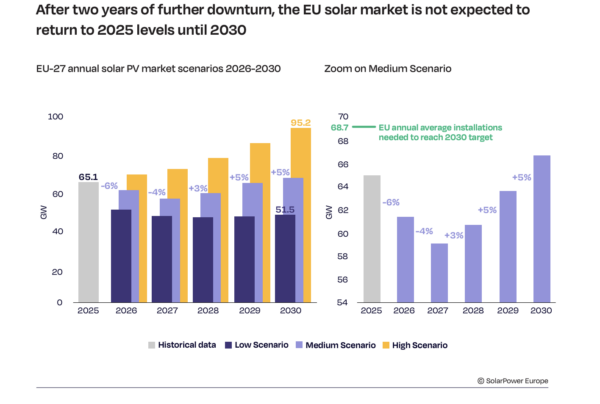
The medium scenario projection would see the EU's solar fleet hit 718 GW by 2030, falling more in line with the aggregate solar target from EU Member States’ National Energy and Climate Plans (NECPs), which currently stands at 701 GW by 2030.
SolarPower Europe attributes the faltering market to an ailing residential solar segment. Home rooftop solar accounted for 14% of solar additions in the EU this year, compared to 19% last year and 28% in 2023. The association explains that the market segment has been impacted by an uncertain post-energy crisis environment that has seen rooftop support schemes cut and the perceived softening of energy price pressure on households.
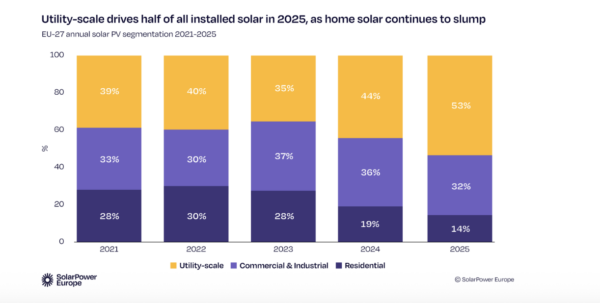
Utility-scale solar accounted for more than half of total deployment this year for the first time, but the segment is still facing challenges associated with profitability due to increasing numbers of negative energy prices, as well as curtailments, grid congestion and unresolved flexibility and storage needs.
In the report’s forward, SolarPower Europe’s Walburga Hemetsberger, Dries Acke and Michael Schmela write that this year’s outlook delivers a clear wake-up call to policymakers, before adding that with decisive and coordinated action, Europe can still reverse the current negative trend.
“The EU urgently needs a decisive push on flexibility with a dedicated EU Flexibility Strategy that unlocks the enormous potential of battery storage and demand-side flexibility,” the trio wrote. “Without this, Europe will not only miss its 2030 solar targets. If solar – the EU’s largest and fastest-growing clean technology – fails to pick up in the next years, the EU will certainly miss its 2030 renewables target of 42.5%.”
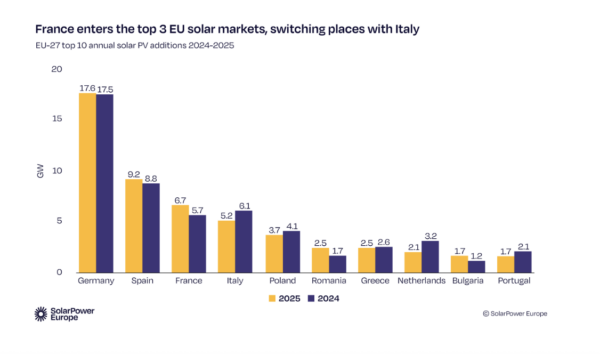
Elsewhere in the report, SolarPower Europe notes the number of GW-scale solar markets in the EU decreased for the first time in a decade this year, with 14 Member States adding over 1 GW of solar in 2025, two less than last year.
Germany and Spain continued to lead the EU’s solar market in 2025, while France replaced Italy in the top three. Romania and Bulgaria entered the top ten solar markets for the first time, with Romania experiencing the fastest growth rate.
This content is protected by copyright and may not be reused. If you want to cooperate with us and would like to reuse some of our content, please contact: editors@pv-magazine.com.


By submitting this form you agree to pv magazine using your data for the purposes of publishing your comment.
Your personal data will only be disclosed or otherwise transmitted to third parties for the purposes of spam filtering or if this is necessary for technical maintenance of the website. Any other transfer to third parties will not take place unless this is justified on the basis of applicable data protection regulations or if pv magazine is legally obliged to do so.
You may revoke this consent at any time with effect for the future, in which case your personal data will be deleted immediately. Otherwise, your data will be deleted if pv magazine has processed your request or the purpose of data storage is fulfilled.
Further information on data privacy can be found in our Data Protection Policy.