





Ireland’s €18.9 billion ($22.2 billion) investment package for 2026-30 has been published by the Commission for the Regulation of Utilities (CRU) and the government. The plan – referred to as Price Review 6 (PR6) – will continue to work with industry and developers to increase the supply of onshore wind and solar electricity by 2030.
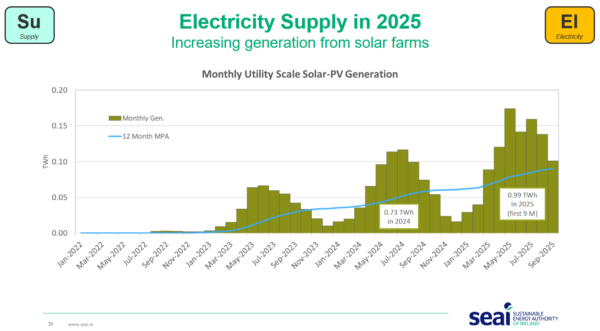
According to the Sustainable Energy Authority of Ireland’s (SEAI) provisional data for 2025, monthly utility-scale solar generation has increased from an average of 0.73 TWh in 2024 to 0.99 TWh in the first nine months of 2025.
Ireland’s total solar PV generation in 2024 reached 1.09 TWh. These figures featured in the SEAI’s Energy in Ireland 2025 report, released December 17.
Of 2024’s total solar generation, 66.8% (0.73 TWh) came from utility-scale, with just over one third (0.36 TWh) coming from rooftop.
These data show Ireland’s renewable energy transition efforts are gaining ground. In November, the island country surpassed 2 GW of installed solar capacity, while in December it reached 1 GW of installed rooftop capacity.
However, a report by the International Energy Agency (IEA) titled Powering Ireland’s Energy Future, emphasized the need to invest in grid infrastructure and system operations. It also looked at how Ireland’s electricity supply could expand over the next 10 years due to increasing demand from electrification of heat and transport, as well as the nation’s growing pipeline of data centers.
As well as grid investment, the IEA recommended that Ireland should expand its generation capacity, storage and demand-side flexibility to ensure sufficient resources to meet adequacy and flexibility needs. Streamlining its project permitting processes will be crucial to this, with the IEA recommending it adopts more digital tools to accelerate permitting processes. It also highlighted the critical importance of energy security and reliability.
“Ireland should strategically assess and choose the composition of its electricity supply portfolio, with potential demand trajectories in mind,” the report stated, adding that Ireland would reach a peak residual demand, or a measure of total demand minus wind and solar output, of 10 GW by 2035.
To cover this demand securely, Ireland needs to develop a portfolio that reaches 16 GW of dispatchable capacity (including thermal generation, storage and interconnectors), the report claimed.
“This would require ambitious development of new battery capacity and higher electricity imports, alongside thermal plants that would operate mainly as backup power supply. Depending on how demand and the supply mix evolve under different policy pathways, revising capacity requirements often will be crucial for prudent planning, along with continued efforts to reduce reliance on imported fossil fuels,” it stated.
Ireland’s Minister for Climate, Energy and the Environment, Darragh O’Brien, welcomed the IEA’s technical assessment and declared that “Ireland is entering into the most significant period of energy infrastructure development since rural electrification,” adding that the forthcoming PR6 investment would deliver on the “bold ambition” needed.
PR6 includes a €3.5 billion government equity investment in Irish electricity infrastructure, as outlined in the revised National Development Plan in July 2025.
As part of this investment, €1.5 billion will be transferred to Ireland’s distribution system operator (DSO) ESB Networks before the end of 2025, to support delivery of onshore electricity infrastructure over the next five years.
PR6 will fund more than 500 capital projects, including 29 priority transmission projects and 27 priority distribution substations.
Spending will also go towards adding new and improving existing underground cables, pole replacements, overhead lines and a dedicated program to ensure energy infrastructure is prepared sufficiently for storms.
It will facilitate the connection of up to 300,000 new homes by 2030 and construction of network infrastructure to support the connection of up to a million electric vehicles and an increased number of heat-pumps.
This content is protected by copyright and may not be reused. If you want to cooperate with us and would like to reuse some of our content, please contact: editors@pv-magazine.com.


By submitting this form you agree to pv magazine using your data for the purposes of publishing your comment.
Your personal data will only be disclosed or otherwise transmitted to third parties for the purposes of spam filtering or if this is necessary for technical maintenance of the website. Any other transfer to third parties will not take place unless this is justified on the basis of applicable data protection regulations or if pv magazine is legally obliged to do so.
You may revoke this consent at any time with effect for the future, in which case your personal data will be deleted immediately. Otherwise, your data will be deleted if pv magazine has processed your request or the purpose of data storage is fulfilled.
Further information on data privacy can be found in our Data Protection Policy.