





Generating power on islands typically involves use of diesel gensets. Due to land and roof space constraints, transitioning to and scaling up renewable power projects is difficult and can limit economic development for islands.
In Maldives, the Soneva group has been working for over three years with Canopy Power on projects to provide sustainable power for its Soneva Fushi and Soneva Jani resorts. Canopy Power designed and built the solar-battery microgrids that currently provide approximately 40-45% of the power needs of the Fushi and Jani resorts.
Sujay Malve, Co-founder and CEO of Canopy Power, says that with Soneva Secret, the resort developer wanted to go beyond that, aiming to reach 75-80% of renewable energy penetration. “Remember, these places are on islands in Maldives. The only way they can generate electricity is from diesel gensets, which produce high emissions, and fuel is expensive and painful from a logistics point of view. Also, Soneva wanted as much independence as possible from the volatility of diesel prices.”

Image: Huawei Digital Power / Canopy Power
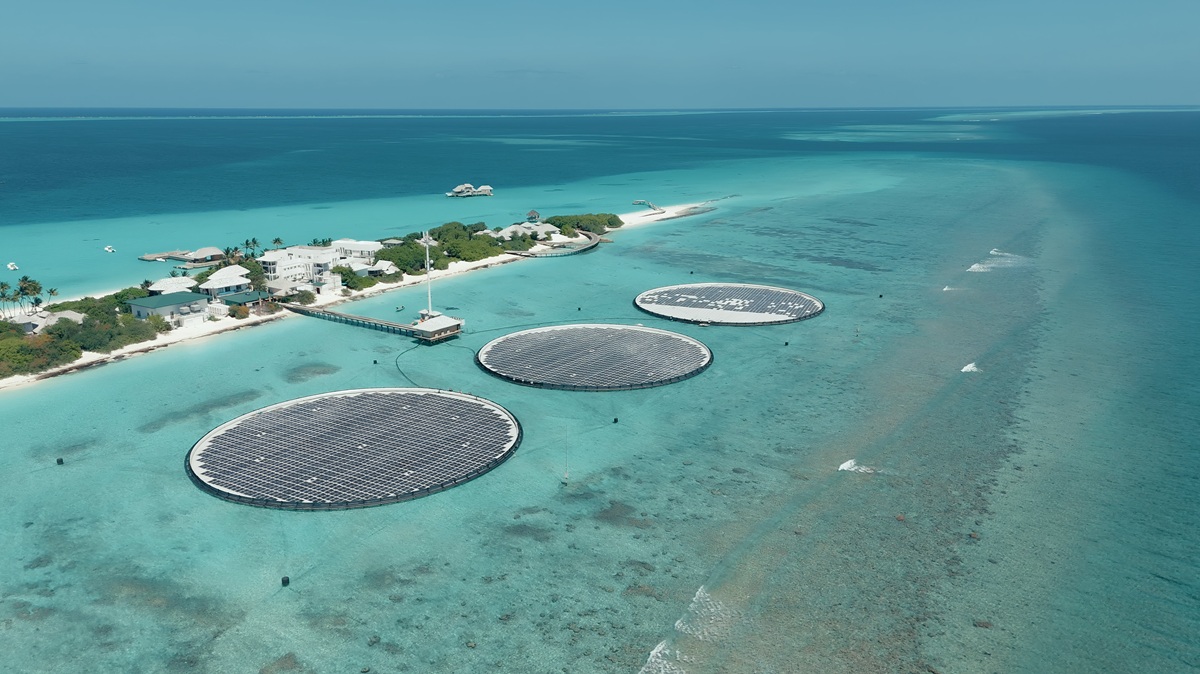
Malve said the biggest problem was where to install the solar panels. Due to the rooftop designs of the resort villas and the limited land, “the only way to do something meaningful is to install over the water surface.” After exploring different options for the 2 MWp solar PV plant, Canopy Power chose Ocean Sun’s membrane-based floating solar technology, paired with a 3 MWh battery storage system by Huawei. “Aesthetics are very important for resorts. Renewable energy installations must look pretty. And if you see the pictures of Ocean Sun's technology, they are just brilliant. They become part of that environment,” Malve said.
Ocean Sun CEO Kristian Torvold said the company’s patented floating structure is based on more than 50 years of Norwegian salmon farming experience. “Instead of trying to put a land-based solar power plant on the water, we’ve taken marine technology and applied solar to it,” Torvold said. Ocean Sun received the first Type Certificate for a floating solar structure from Bureau Veritas Marine & Offshore. According to Torvold, the structure of the 70-meter diameter rings is robust and can handle large waves and hurricane-strength winds because the modules are resting flat on the membrane.

Image: Huawei Digital Power / Ocean Sun
Because the modules lie flat on the membrane, they're directly cooled by the water underneath the membrane. Torvold said, “In places like the Maldives, you'll see efficiency actually increase up to 10% from the cooling of the cells.” The flat structure helps the system blend in with the ocean, enhancing the aesthetic value that Malve referred to as an important factor for the Soneva Secret project. According to Torvold, “from the beach, you don't see it very well. It's a flexible structure that moves with the ocean.”
Malve said the Soneva Secret system is designed to enable the resort to turn its gensets off for 16 to 18 hours per day. “This is going to save 900,000 to 1,000,000 liters of diesel per year, which leads to 2,000 plus tons of CO2 emissions reduction.” Canopy Power’s remote monitoring management platform – called Hornbill – helps keep O&M costs low. Malve added that the payback period for Soneva Secret “will be less than five years, for a system that is built to last two decades. Huawei’s smart string inverters and the next-generation batteries installed at Soneva Secret ensure high up-time and a reliable and continuous power supply. This system works autonomously with minimal human interference.”
“The solution is not only applicable for high-end resorts,” Torvold emphasized. “It is affordable energy compared to diesel, and it can electrify islands that currently lack industry or infrastructure. So, I see this as an enabler for economic growth, creating business opportunities due to stable and low-cost energy and improving the lives of island communities around the world.”
This content is protected by copyright and may not be reused. If you want to cooperate with us and would like to reuse some of our content, please contact: editors@pv-magazine.com.


By submitting this form you agree to pv magazine using your data for the purposes of publishing your comment.
Your personal data will only be disclosed or otherwise transmitted to third parties for the purposes of spam filtering or if this is necessary for technical maintenance of the website. Any other transfer to third parties will not take place unless this is justified on the basis of applicable data protection regulations or if pv magazine is legally obliged to do so.
You may revoke this consent at any time with effect for the future, in which case your personal data will be deleted immediately. Otherwise, your data will be deleted if pv magazine has processed your request or the purpose of data storage is fulfilled.
Further information on data privacy can be found in our Data Protection Policy.