





Agriculture in the United Arab Emirates (UAE) faces extreme challenges due to intense summer heat (>40 C), and persistent water scarcity. Across the Middle East and North Africa, nearly 90% of land is arid or semi-arid, making large-scale crop production difficult. At the same time, the region benefits from some of the world’s highest solar irradiation levels, offering strong potential for renewable energy. However, large-scale solar farms – often the primary choice to tap this potential – compete with scarce arable land.
Arid regions like the UAE face simultaneous challenges in producing sufficient food, water, and electricity to meet their population’s needs. The solution lies in agrivoltaics, which integrates solar panels above crops to allow the same land to produce both food and energy. To test this approach in arid conditions, the Fujairah Research Centre – led by Dr. Fouad Lamghari Ridouane, in partnership with AE Solar, led by Dr. Hamed Hanifi, Director of Technology & Innovation – launched a pilot project. The initiative evaluated technical feasibility, agricultural productivity, and environmental impact, combining PV system modelling, agronomic monitoring, and microclimate analysis.
Desert-ready setup
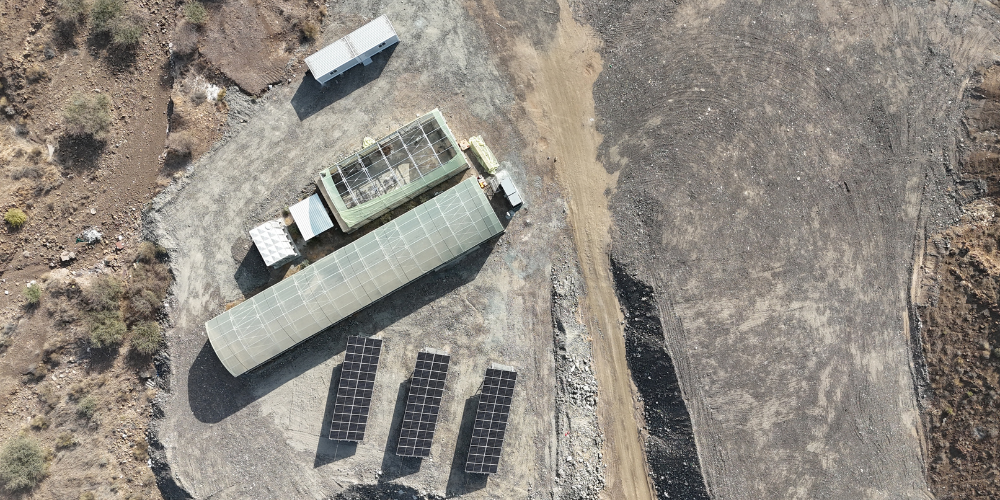
Installed in Al Fujairah City, the system features a 38.9 kWp PV array of 72 modules paired with a 320 kWh lithium-ion battery bank. A reinforced ground-mount structure was used instead of specialized agri-PV frames, reducing costs and improving scalability while maintaining uniform shading. High-temperature power electronics (>50 C rating) ensured reliable operation during peak summer, preventing derating losses typical in desert climates.
Agronomic monitoring
This project is the first documented agrivoltaic trial on native UAE plants, comparing growth under solar panels with open-field conditions. Plants were monitored in May and June 2025 for growth and physiological responses, while temperature, relative humidity, and photosynthetic photon flux density (PPFD) were recorded to understand microclimate effects. PPFD is a measurement in agriculture of how much “useful light” plants receive. Smart layouts and the right PV modules can reduce heat stress while keeping PPFD in the optimal range.
Stronger crops, longer seasons
The results were striking. Under the solar panels, a unique microclimate emerged:
- 15 C lower temperature
- Over 30% higher humidity
- Impressively higher PPFD
- 20–30% lower salt content, along with higher organic matter and more beneficial minerals, improving fertility
As a result, plants showed notable growth improvement:
- Increased shoot development
- Stronger root system
- More leaves per plant
This demonstrates that controlled shading from PV modules can enhance plant health, improve water retention, and boost crop resilience in arid climates, offering promising benefits for regional agriculture.
Scalable model
As the technology partner, AE Solar supplied the photovoltaic panels and provided technical expertise for the project’s design and implementation. The collaboration has transformed the Fujairah pilot from a research concept into a field-tested demonstration of agrivoltaic feasibility under harsh climatic conditions. Its agrivoltaic system offers a practical, scalable solution that meets the region's growing energy, food, and water challenges all at once.
This content is protected by copyright and may not be reused. If you want to cooperate with us and would like to reuse some of our content, please contact: editors@pv-magazine.com.

By submitting this form you agree to pv magazine using your data for the purposes of publishing your comment.
Your personal data will only be disclosed or otherwise transmitted to third parties for the purposes of spam filtering or if this is necessary for technical maintenance of the website. Any other transfer to third parties will not take place unless this is justified on the basis of applicable data protection regulations or if pv magazine is legally obliged to do so.
You may revoke this consent at any time with effect for the future, in which case your personal data will be deleted immediately. Otherwise, your data will be deleted if pv magazine has processed your request or the purpose of data storage is fulfilled.
Further information on data privacy can be found in our Data Protection Policy.