




What factors are driving the shift to advanced solar PV module technologies for C&I rooftop projects in Europe?
Chao Jia: Businesses across Europe are dealing with volatile energy prices and growing pressure to decarbonize core operations, while grid connections are constrained or delayed. Many companies want to produce more of their own electricity but face limited rooftop space, complex building structures, and uncertainty around long-term returns. Renewable investments have to compete with core business priorities, and payback periods are scrutinized more closely than ever.
For EPCs and installers, labor shortages persist, margins are tight, and projects are expected to be delivered faster and with fewer risks. Rooftop projects have become more complex, with shading, load limits, and safety considerations playing a larger role. At the same time, EPCs are increasingly asked to stand behind performance guarantees and long-term system reliability.
As we begin 2026, banks and lenders are increasingly focused on predictable cash flows, long-term performance, and technology risk. Module quality, reliability, and proven field performance sit at the core of bankability assessments and investment decisions.
All of this is changing how solar decisions are made, which is why advanced module technologies are gaining relevance. They respond directly to what businesses and EPCs need today.
Why are advanced solar technologies such as back contact getting increased attention from installers, developers, and asset owners?
Chao Jia: As projects become more complex, tolerance to shading, heat stress, and partial-load conditions becomes decisive. This is where back contact has demonstrated clear advantages in practice.
In our own field experiments and stress tests, mainstream technologies such as TOPCon showed weaknesses under realistic rooftop conditions, particularly under shading and heat stress. In practice, this leads to yield losses, higher thermal stress, and increased operational risk.
Increased efficiency also plays a role. Back contact cells in mass production today operate at efficiency levels of around 27%, with module efficiencies above 24%. There is still clear development potential. With continued optimization of the cell architecture, we expect cell efficiencies to move toward roughly 28.5% over the next three to five years, with corresponding module efficiencies exceeding 26%.
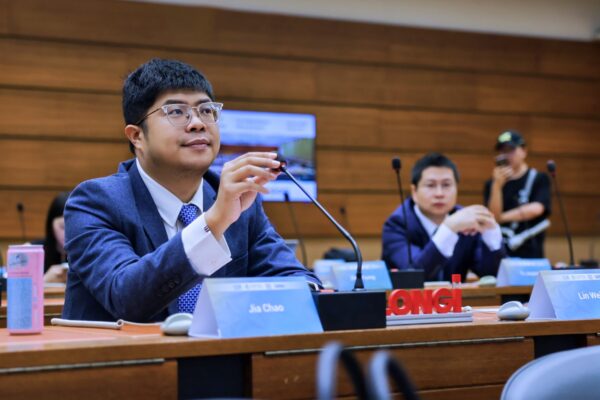
Image: LONGi
How is the solar market evolving beyond price as the prime consideration for PV module purchases?
Chao Jia: Project owners, EPCs, and financiers have learned over recent years that the lowest upfront cost does not automatically lead to the best project outcome. As margins tighten and projects become more complex, attention has shifted toward lifetime performance, risk management, and predictability. That means yield stability, thermal behavior, safety under shading, and long-term degradation now play a much bigger role in procurement decisions than they did in the past.
This evolution also changes what growth means for solar manufacturers. Competing purely on price has proven to be neither resilient nor sustainable. To create real differentiation and offer premium, high-performance modules, sustained investment in R&D has become essential. Continuous innovation allows manufacturers to improve real-world performance and long-term value, rather than focusing on short-term cost reductions.
How can module manufacturers leverage their R&D strategy to remain competitive in 2026?
Chao Jia: I think the market shift shows how important it is to listen closely to what customers need. As requirements evolve, products and innovative features have to follow.
That means R&D has to start with real project conditions. Today, innovation is about solving the daily practical challenges installers, asset owners, and financiers face. Performance under heat, shading, and long operating periods has become just as important as nameplate efficiency.
Another important aspect is flexibility. In today’s market, competitiveness increasingly depends on how quickly a manufacturer can translate specific customer needs into practical solutions.
Flexible R&D combined with flexible manufacturing allows companies to respond to these requirements, while others struggle because they are locked into standardized products and price-driven capacity utilization.
The questions and responses in this sponsored interview article were provided by LONGi.
This content is protected by copyright and may not be reused. If you want to cooperate with us and would like to reuse some of our content, please contact: editors@pv-magazine.com.

By submitting this form you agree to pv magazine using your data for the purposes of publishing your comment.
Your personal data will only be disclosed or otherwise transmitted to third parties for the purposes of spam filtering or if this is necessary for technical maintenance of the website. Any other transfer to third parties will not take place unless this is justified on the basis of applicable data protection regulations or if pv magazine is legally obliged to do so.
You may revoke this consent at any time with effect for the future, in which case your personal data will be deleted immediately. Otherwise, your data will be deleted if pv magazine has processed your request or the purpose of data storage is fulfilled.
Further information on data privacy can be found in our Data Protection Policy.