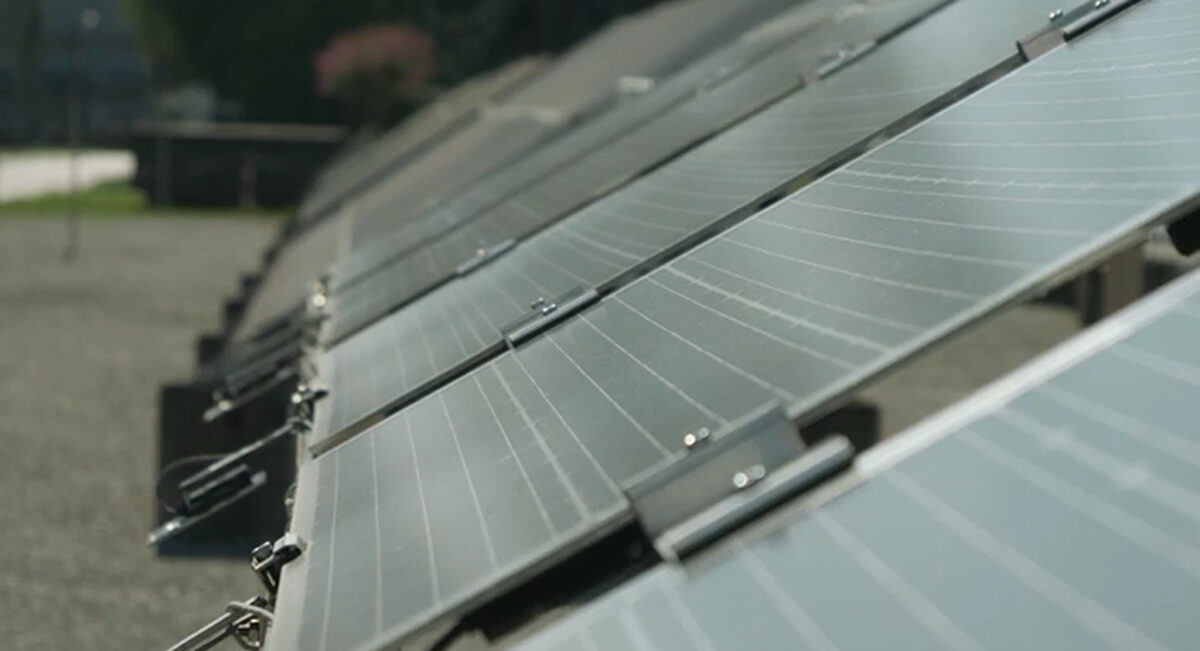





A group of scientists from the European Commission Joint Research Centre (JRC) has tested the performance of two single-junction perovskite solar module over a 1-year period and has concluded the testing provided “stable results.”
“We believe the test delivered a promising result for perovskite solar modules,” lead researcher Hanna Ellis told pv magazine. “We must be aware that all new technologies present challenges in their first deployment. For perovskite technology to be adequately judged more independent studies of outdoor performance of commercial modules are needed.”
“We attempted to address two issues within this article; the challenge of demonstrating that we can perform repeatable and reliable characterisation of perovskite modules, and the ability of the perovskite module to continue to perform at this level in real world conditions. We consider that the initial characterization is the most significant result for the commercialization of this technology, while the longer-term stability is very promising,” she went on to say.
The research team developed a new preconditioning methodology for electrical characterization. It used a light-soaking approach similar to that employed in conventional technologies, which has been shown to be suitable for commercial perovskite modules.
In the study “Outdoor Measurements of Perovskite Modules,” published in Progress in Photovoltaics, the researchers explained that the light soaking effect (LSE) represents the major cause affecting the thermal stability of perovskite solar cells and modules. This effect can have an impact on cell efficiency, short-circuit current and open-circuit voltage under constant illumination, when cell performance evolves with time because illumination activates several slow physical and chemical processes inside the device.
“The LSE phenomenon limits the reliability of the measured and modelled power output of the perovskite solar cells, and therefore, the research field is investigating mechanisms and strategies for understanding and mitigating the LSE,” the academics emphasized.
Testing was performed on two south-oriented glass-glass 0.7164 m² perovskite modules in outdoor environment at the European Solar Test Installation (ESTI) in Ispra, northern Italy over a one-year period from June 2024 to June 2025. The panels were deployed on fixed structures with a tilt angle of 45° and were labeled as YZ517 and YZ518. In addition, a third reference module called YZ519 was used during the measurement protocol investigations
Prior to outdoor installation under natural sunlight, the modules were characterized indoors under simulated illumination. For the outdoor measurements, the group used an ESTI sensor, an anemometer, temperature sensors, a pyranometer and conventional monitoring instrumentation.
The testing showed that the YZ518 module suffered significant degradation, with efficiency dropping below 7% by May 2025 compared to its initial indoor value. In contrast, YZ517 remains more stable, maintaining efficiency values around 12–13% in May 2025 after peaking above 15% in June–July 2024. Moreover, YZ517 was found to have a pronounced seasonal variation, with efficiency decreasing during winter and recovering in spring but, overall, it demonstrated “stable” performance and was therefore selected for further analysis as a function of irradiance, temperature, and time of day.
This analysis showed that, during warm summer periods following several sunny days, the YZ517 panel achieved higher efficiency values in the morning at lower temperatures compared to the afternoon at similar irradiance. However, seasonal effects were present: on sunny days in November and December following cloudy periods, deviations occurred in efficiency performance as a function of irradiance, and with afternoon and morning values being similar at comparable irradiances.
“We believe that one year outdoor operation is a significant milestone, however further studies and longer-term exposure are necessary to improve our understanding and further validate the technology,” Ellis concluded, explaining that further investigation is required to fully understand the influence of irradiance, temperature, and seasonal weather conditions on perovskite solar cell performance.
This content is protected by copyright and may not be reused. If you want to cooperate with us and would like to reuse some of our content, please contact: editors@pv-magazine.com.


By submitting this form you agree to pv magazine using your data for the purposes of publishing your comment.
Your personal data will only be disclosed or otherwise transmitted to third parties for the purposes of spam filtering or if this is necessary for technical maintenance of the website. Any other transfer to third parties will not take place unless this is justified on the basis of applicable data protection regulations or if pv magazine is legally obliged to do so.
You may revoke this consent at any time with effect for the future, in which case your personal data will be deleted immediately. Otherwise, your data will be deleted if pv magazine has processed your request or the purpose of data storage is fulfilled.
Further information on data privacy can be found in our Data Protection Policy.