




From pv magazine France
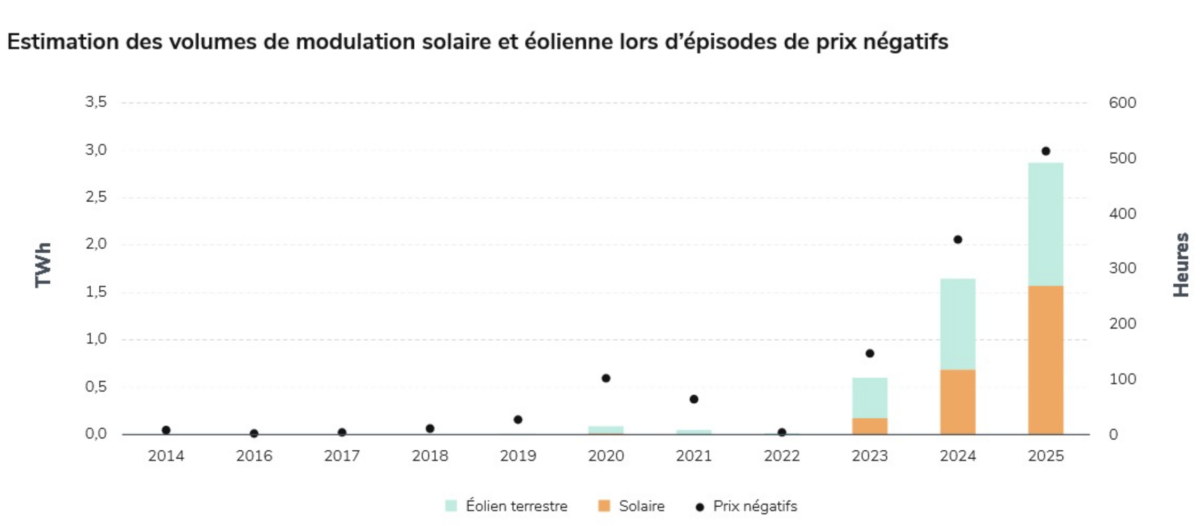
New data from Réseau de Transport d’Électricité (RTE), France’s transmission system operator, shows that renewable energy curtailed during negative-price periods nearly doubled compared with 2024, reaching almost 3 TWh. The increase reflects growing integration challenges as solar and wind capacity expands.
Rising renewable output and more hours with zero or negative wholesale prices forced operators to modulate production more frequently. Non‑dispatchable generation – primarily solar and wind – accounted for most of the curtailment.
Much of the change stems from a sharp rise in solar curtailment. An increasing share of France’s renewable fleet now operates under “complément de rémunération” (premium) schemes, incentivizing generators to adjust output in response to market signals. By year-end, wind and solar capacity capable of modulation had climbed, supported by regulatory reforms and new grid-connection rules.
RTE reported total electricity production of about 547.5 TWh in 2025, slightly higher than 2024. Nuclear generation continued to recover following maintenance, while hydropower fell from record 2024 levels due to lower rainfall. Renewables maintained growth, while fossil-fuel generation declined further. Low-carbon sources, including nuclear and renewables, accounted for more than 95% of total generation.
Higher renewable curtailment reflects system flexibility: generators reducing output help prevent grid imbalances during oversupply. However, more frequent negative-price periods underline the need for enhanced flexibility solutions such as storage, demand response, and improved forecasting to maximize clean energy use while maintaining stability.
This content is protected by copyright and may not be reused. If you want to cooperate with us and would like to reuse some of our content, please contact: editors@pv-magazine.com.


By submitting this form you agree to pv magazine using your data for the purposes of publishing your comment.
Your personal data will only be disclosed or otherwise transmitted to third parties for the purposes of spam filtering or if this is necessary for technical maintenance of the website. Any other transfer to third parties will not take place unless this is justified on the basis of applicable data protection regulations or if pv magazine is legally obliged to do so.
You may revoke this consent at any time with effect for the future, in which case your personal data will be deleted immediately. Otherwise, your data will be deleted if pv magazine has processed your request or the purpose of data storage is fulfilled.
Further information on data privacy can be found in our Data Protection Policy.