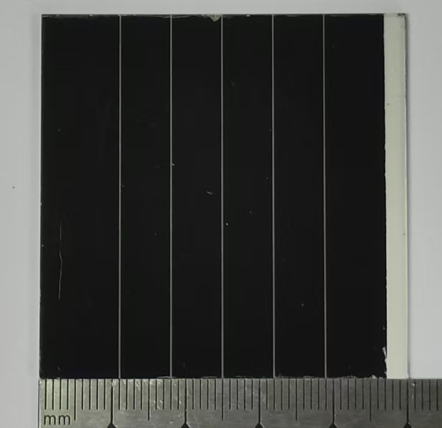





Researchers at Spain's University of the Basque Country (UPV/EHU) have fabricated a perovskite solar cell based on a light absorber incorporating two-dimensional titanium carbide (Ti3C2Tx), which is also known as MXene.
MXene compounds take their name from their graphene-like morphology and are made via selective etching of certain atomic layers from a bulk crystal known as MAX. Recently, these materials have shown promise for use in PV technology due to their unique optoelectronic properties, such as their large charge carrier mobility, excellent metallic conductivity, high optical transmittance, and tunable work function (WF).
“We placed MXene at the interface of the electron transport layer (ETL) based on tin oxide (SnO2) and the perovskite absorber to minimize oxygen vacancy and defects,” the research's corresponding author, Shahzada Ahmad, told pv magazine. “The chlorine-terminated MXenes we used significantly reduced the oxygen vacancy present at the buried interface.”
Terminating Mxene with chlorine helped to effectively reduce pinholes and particle aggregation that are commonly associated to the dispersion of MXene in the absorber, the scientists said.
Through scanning electron microscopic (SEM) images, they could verify that the placement of the Mxene interlayer underneath the perovskite layer creates changes in the patterns and a different crystallization surface in the perovskite material, with Raman spectroscopy also finding enhanced crystal quality.
Further analysis confirmed that the bonding between the MXene layer and SnO2 eliminates oxygen vacancies on the SnO2 surface and mitigates interactions with existing surface defects.
The academics built the cell with a substrate made of indium tin oxide (ITO), the SnO2 ETL, the Mxene layer, the perovskite absorber, a hole transport layer (HTL) based on Spiro-OMeTAD, and gold (Au) metal contact.
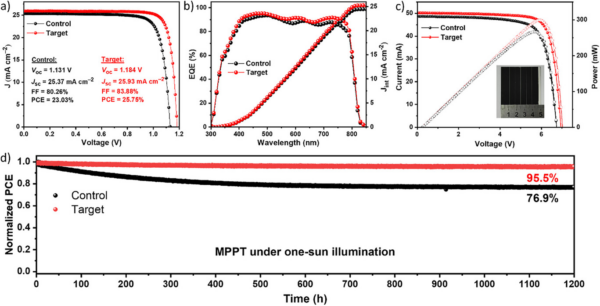
Tested under standard illumination conditions, the device achieved a power conversion efficiency of 25.75%, an open-circuit voltage of 1,184 mV, a short-circuit density of 25.93 mA cm2, and a fill factor of 84%. By comparison, a reference cell without the Mxene interlayer achieved an efficiency of 23.03%, an open-circuit voltage of 1,131 mV, a short-circuit density of 25.37 mA cm2, and a fill factor of 80%.
The cell was also able to retain 95.5% of the initial efficiency after 1,200 h, with the control device achieving only 76.9%.
“This is the highest performance and stability reported with using MXenes or any other type of 2D-materials,” Ahmad stated. “This result depends on the simultaneous gains in both open-circuit voltage and fill factor, which stem from suppressed non-radiative recombination and improved charge extraction at the SnO2-perovskite interface.”
“We then used this MXene-adjusted device architecture to fabricate a module and measured 21.76% performance and boosted stability,” Ahmad added, noting that future research will be focused on scaling up from cell to module.
The cell was described in “Environmental Benign Cl-Terminated MXene For Buried Interface Engineering in Perovskite Solar Modules,” published in Advanced Functional Materials. The research team included scientists from Huazhong University of Science and Technology (HUST).
Previous attempts to use Mxene in perovskite solar cells resulted in devices with 23% efficiency, 17% efficiency, and 25.13% efficiency. Separately, another international research group recently conducted a review to find out how MXenes could be used as materials for solar cells
This content is protected by copyright and may not be reused. If you want to cooperate with us and would like to reuse some of our content, please contact: editors@pv-magazine.com.


By submitting this form you agree to pv magazine using your data for the purposes of publishing your comment.
Your personal data will only be disclosed or otherwise transmitted to third parties for the purposes of spam filtering or if this is necessary for technical maintenance of the website. Any other transfer to third parties will not take place unless this is justified on the basis of applicable data protection regulations or if pv magazine is legally obliged to do so.
You may revoke this consent at any time with effect for the future, in which case your personal data will be deleted immediately. Otherwise, your data will be deleted if pv magazine has processed your request or the purpose of data storage is fulfilled.
Further information on data privacy can be found in our Data Protection Policy.