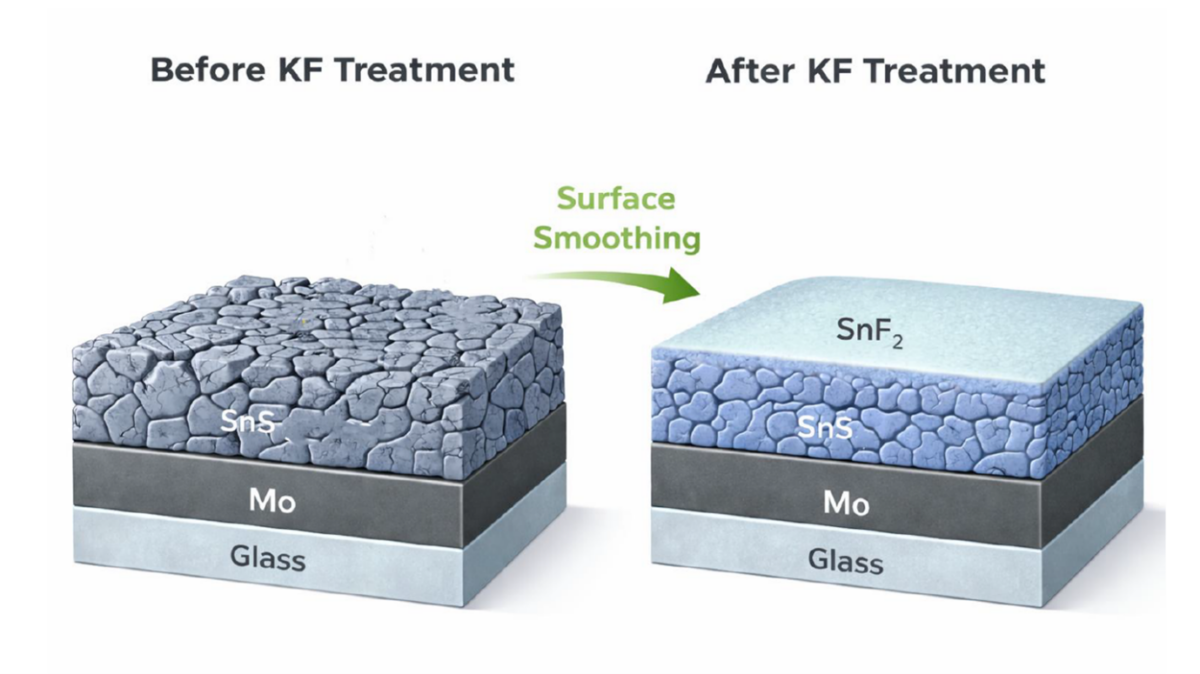





Research led by Chonnam National University in South Korea has improved the performance of tin monosulfide (SnS) solar cells with a potassium fluoride-assisted (KF) post-treatment and a vapor transport deposition (VTD) process. The treated solar cells had a power conversion efficiency of 4.10% and reduced recombination sites, compared to control devices.
The research topic is complementary to the research group's earlier germanium oxide (GeOx) interlayer study, which achieved a 4.81% cell efficiency, according to first author of the research, Rahul Kumar Yadav.
“The KF treatment enhances the intrinsic quality of the SnS absorber surface, providing a superior foundation for subsequent interface engineering, while the GeOx interlayer optimizes band alignment and suppresses recombination at the rear contact,” Kumar Yadav, told pv magazine.
“In our ongoing work, we are actively combining KF surface treatment with GeOx back interface engineering, as we expect their integration to deliver further gains in voltage, operational stability, and overall device efficiency,” he added.
In the study, the researchers varied the concentration of KF solution to measure the effect of drop-cast KF surface treatment on the structural, morphological, and photovoltaic properties of VTD-SnS absorber layers.
Testing showed that the KF treatment enhanced “film uniformity, densification, and wettability.” Devices based on the optimized KF-treated SnS absorber had a PCE 4.10%, an improvement compared to 3.42% for untreated devices, with further analysis revealing reduced recombination sites.
“The KF-assisted solution post-treatment functions as a surface modulation step, improving grain connectivity, reducing surface roughness, and passivating electrically active defects,” said Kumar Yadav, adding that the resulting higher open-circuit voltage and fill factor, enabled enhanced efficiency “without altering the overall device architecture.”
The researchers concluded that the research represents a “scalable strategy to overcome key interfacial limitations” and to advance SnS thin-film photovoltaics.
Also participating in the study were Korea Aerospace University and Kyungpook National University.
The work is detailed in “Modulating surface morphology via potassium fluoride-assisted solution post-treatment enables VTD-SnS thin film solar cells to achieve over 4% efficiency,” which appears in Materials Today Energy.
Looking ahead, the group is focused on developing SnS thin-film solar cells beyond the 4% efficiency threshold “through coordinated absorber surface, heterojunction interface, and rear interface engineering, while maintaining compatibility with scalable manufacturing processes,” said Kumar Yadav.
This content is protected by copyright and may not be reused. If you want to cooperate with us and would like to reuse some of our content, please contact: editors@pv-magazine.com.


By submitting this form you agree to pv magazine using your data for the purposes of publishing your comment.
Your personal data will only be disclosed or otherwise transmitted to third parties for the purposes of spam filtering or if this is necessary for technical maintenance of the website. Any other transfer to third parties will not take place unless this is justified on the basis of applicable data protection regulations or if pv magazine is legally obliged to do so.
You may revoke this consent at any time with effect for the future, in which case your personal data will be deleted immediately. Otherwise, your data will be deleted if pv magazine has processed your request or the purpose of data storage is fulfilled.
Further information on data privacy can be found in our Data Protection Policy.