





Australian households and businesses installed more rooftop solar last month than in any other month on record with new data from solar and storage market analyst SunWiz showing 442 MW of sub-100 kW rooftop PV capacity was registered nationwide in April 2026.
This marked a 31% increase on the 341 MW registered across the country in March and is almost double the 225 MW of new capacity registered in April 2025.
“We have now reached the strongest month in the history of STC (small-scale technology certificates),” SunWiz Managing Director Warwick Johnston said, adding that the market is now running 35% ahead of the same point in 2025.
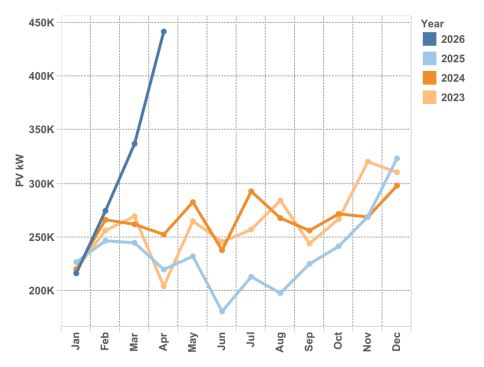
Johnston said the surge in solar registrations was largely a byproduct of changes to the federal government’s Cheaper Home Batteries Program, which has supported the installation of more than 350,000 small-scale battery energy storage systems over the past 10 months.
Changes to the rebate scheme, that provides discounts of up to 30% on the upfront cost of installing small-scale battery systems alongside new or existing rooftop solar, were introduced on 1 May 2026. In the wake of the changes, systems installed through the program will continue to receive the full discount on the first 14 kWh of usable capacity, while 14-20 kWh batteries will get 60% of the discount and 28-50 kWh batteries will get 15% of the rebate.
Johnstone said the adjustments to the battery rebate scheme had “triggered a surge in battery demand with a meaningful flow-on effect to solar.”
“The rebate cut sent households scrambling for large-format (40–50 kWh) batteries, and the bigger solar arrays needed to run them followed, turning the Cheaper Home Battery Program into a multiplier well beyond its original scope,” he said.
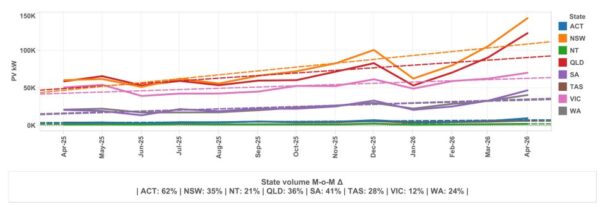
Every state posted growth in rooftop solar installations in April with 143 MW of new capacity registered in New South Wales alone, up 35% on the previous month.
The Australian Capital Territory reported a 62% increase while Queensland delivered a 36% month-on-month increase.
SunWiz said most rooftop PV segments had recorded growth over the month with the 20-30 kW segment the standout, delivering almost double the installed capacity compared to March, up 98%.
The 15-20 kW segment increased by 61% while the 30-50 kW segment recorded growth of 45%. The 3-6 kW and 6-8 kW segments showed minor dips in month-on-month capacity growth.
The growth in the larger segments saw the national average system size bump up to 11.35 kW.
This content is protected by copyright and may not be reused. If you want to cooperate with us and would like to reuse some of our content, please contact: editors@pv-magazine.com.



By submitting this form you agree to pv magazine using your data for the purposes of publishing your comment.
Your personal data will only be disclosed or otherwise transmitted to third parties for the purposes of spam filtering or if this is necessary for technical maintenance of the website. Any other transfer to third parties will not take place unless this is justified on the basis of applicable data protection regulations or if pv magazine is legally obliged to do so.
You may revoke this consent at any time with effect for the future, in which case your personal data will be deleted immediately. Otherwise, your data will be deleted if pv magazine has processed your request or the purpose of data storage is fulfilled.
Further information on data privacy can be found in our Data Protection Policy.