April ENSO shift lifts northern coastal irradiance while suppressing Brazil and northern Argentina
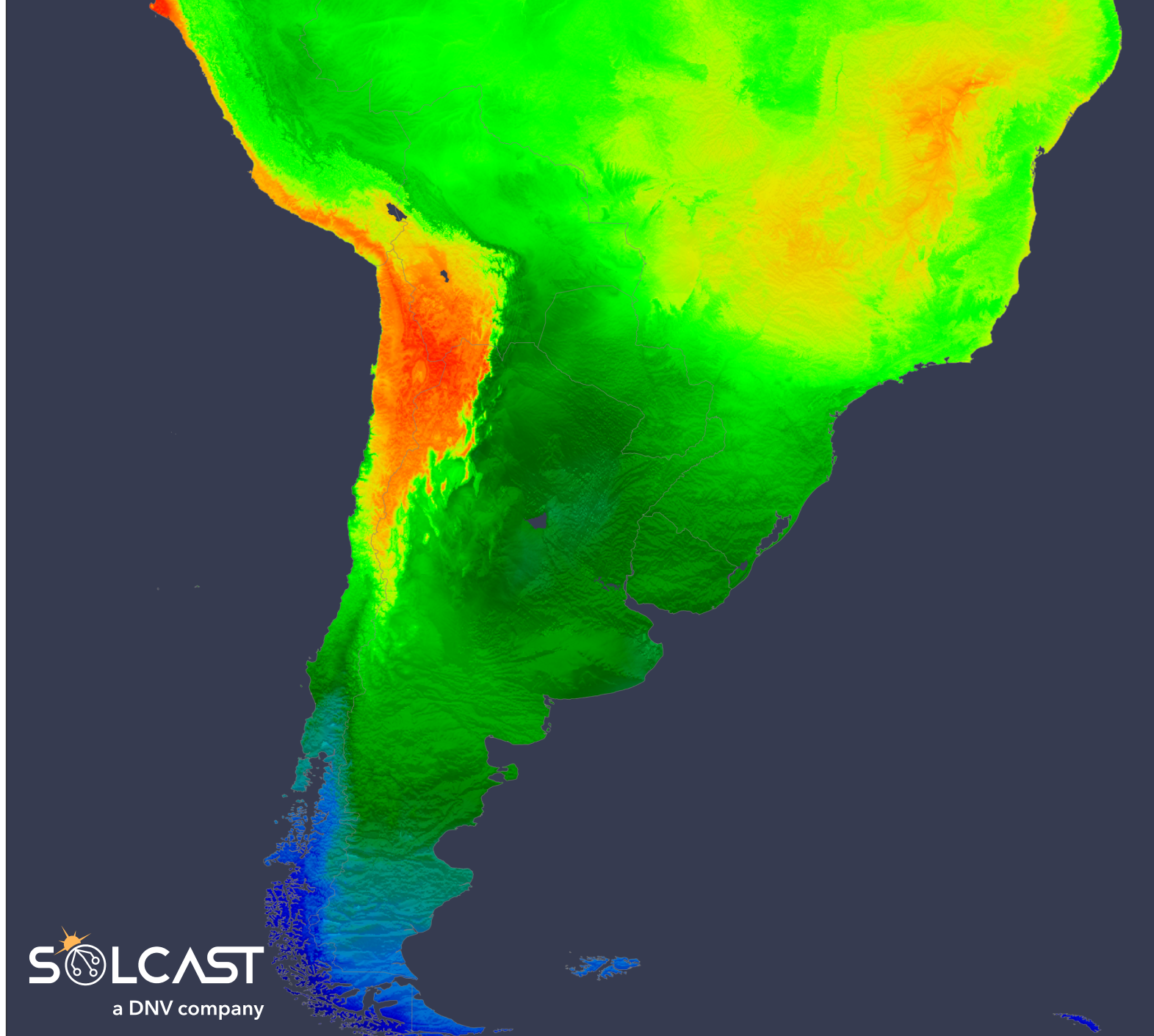
April 2026 delivered sharply contrasting solar irradiance outcomes across South America, with gains along parts of the northern coastline and southern Argentina offset by notable reductions in eastern and northern temperate regions, according to analysis using the Solcast API. These patterns aligned closely with cloud and precipitation anomalies typical of an ENSO-neutral to El Niño transition, producing regionally divergent responses rather than a continent-wide signal.

Across northern South America, April saw clear positive anomalies in surface irradiance along both the Pacific and Caribbean coasts of Colombia. The GHI deviation map shows values around 10–20% above the 2007–2025 average, consistent with reduced cloud formation along coastal zones. This pattern is characteristic of ENSO transition periods, when atmospheric circulation becomes more variable and convection shifts away from some coastal regions. A paper from the NOAA Climate Prediction Centre issued on 9 April 2026 confirmed that conditions were moving from ENSO-neutral toward El Niño, a phase known to disrupt typical cloud and rainfall distributions rather than uniformly enhancing tropical convection. During these transition seasons, localised reductions in cloudiness can emerge, increasing solar performance despite future uncertainty.
In contrast, the region from Buenos Aires to Bolivia experienced suppressed irradiance through April, driven by wetter-than-average conditions and persistent cloud cover. Reports of uneven but enhanced rainfall along the southern Brazilian coast and into northern Argentina point to sustained cloud fields that limited solar production. This coastal strip is particularly sensitive to cloud-driven reductions in irradiance during wetter periods, as marine moisture and onshore flow can maintain extensive low and mid-level cloud. While this suppression dominated the far south of Brazil, northern and parts of northeastern Brazilian coastal segments showed more mixed conditions, with localised positive or near-neutral GHI anomalies despite the broader southern downturn.

Argentina displayed an inverted pattern, with northern regions experiencing irradiance suppression while southern areas fared comparatively better. Climate monitoring for April 2026 indicates precipitation totals well above normal across Buenos Aires and northeastern Argentina, with accompanying cloud limiting solar irradiance. Research shows that in ENSO patterns like we are in now, these phases can systematically reduce irradiance in northern Argentina while leaving southern regions largely unaffected or even slightly enhanced, matching the pattern we saw in April.
Solcast produces these figures by tracking clouds and aerosols at 1-2km resolution globally, using satellite data and proprietary AI/ML algorithms. This data is used to drive irradiance models, enabling Solcast to calculate irradiance at high resolution, with typical bias of less than 2%, and also cloud-tracking forecasts. This data is used by more than 350 companies managing over 300 GW of solar assets globally.
The views and opinions expressed in this article are the author’s own, and do not necessarily reflect those held by pv magazine.
This content is protected by copyright and may not be reused. If you want to cooperate with us and would like to reuse some of our content, please contact: [email protected].
Please login to comment