Emiliano Bellini


Taiwanese utility sets up renewables bidding platform
Taipower has developed a new platform to sell renewable energy to small- and medium-sized businesses. The power utility plans to sell 50 GWh of clean energy by the end of this year.
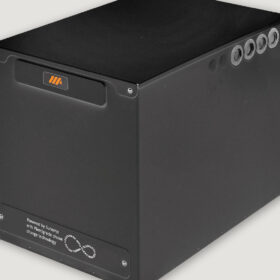
Triple Solar introduces residential thermal battery
Dutch company Triple Solar has launched a residential thermal battery with a heat loss rate ranging from 0.67 kWh/day to 0.84 kWh/day. The new product can reportedly provide hot water at temperatures ranging from 45C and 55C, with the minimum heat source temperature ranging between 65C and 80C.
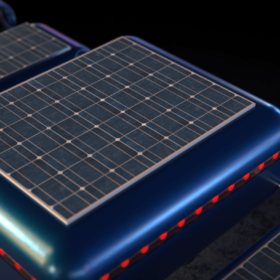
U.S. startup launches scalable wave energy converter, usable with solar
Hawaii-based Wavr LLC is developing a wave energy converter that is designed to be scaled up and integrated with other renewable energy technologies. The startup plans to sell a version integrating five 40 W solar panels at $2,300.
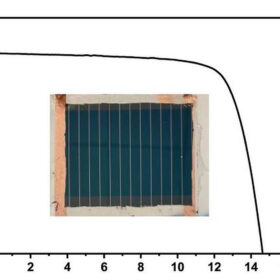
Large-area perovskite-silicon tandem PV cell hits record efficiency of 25.1%
US scientists have achieved a breakthrough in PV cell tech by creating a 24 cm2 perovskite-silicon tandem solar cell. It positions a lithium fluoride interlayer between a hole transport layer and the perovskite absorber to reduce shunting losses.
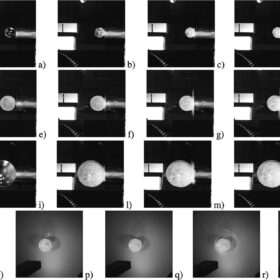
New hail test to assess impact of large, high-velocity ice balls on solar panels
A research group in Switzerland has enhanced the hail test stand to measure the impact of ice balls with larger diameters and higher speed on solar panels. The new testing approach will reportedly enable solar panel makers to assess their products with adequate safety margins.

Mibet presents new solar carport with waterproof design
Mibet has developed a new solar carport with a waterproof design, allowing the deployment of framed and unframed solar panels with tilt angles ranging from 5 degrees to 15 degrees, in either portrait or landscape configurations.
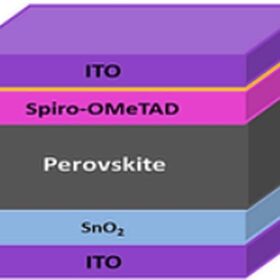
Bifacial perovskite solar cells for indoor applications achieve 30.3% efficiency
Scientists in India have fabricated indoor bifacial perovskite solar cells that purportedly achieve remarkable power output per single cell. The devices also reached a bifaciality factor of 0.73.
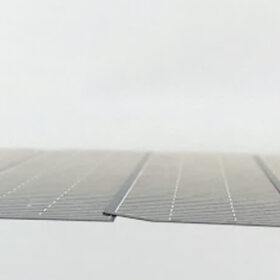
First attempt to build ‘shingled’ perovskite-silicon tandem solar cells
Fraunhofer ISE researchers have demonstrated for the first time the feasibility of the shingling approach with perovskite-silicon tandem solar cells. They also produced full format photovoltaic modules with a power conversion effciency of 22.8%.

Hybrid photovoltaic-tidal energy system for island resorts
Scientists in India have proposed to combine solar PV with tidal energy and storage to cover the entire electricity demand of island resorts. They found the system could help to reduce energy costs for residents and businesses.
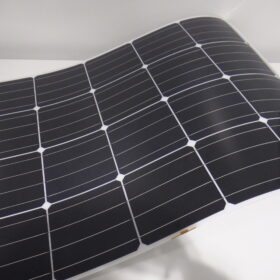
Japanese scientists design flexible crystalline silicon solar modules with PET front cover
The new solar panels have flexible properties and are suitable for roofs with loading restrictions. According to their creators, the modules showed high reliability under both high temperature and high humidity conditions.
