Emiliano Bellini


Uzbekistan launches 400 MW solar tender
The central Asian nation and the International Finance Corporation are seeking proposals for two 200 MW solar parks planned in the Samarkand and Jizzakh regions. The projects will be awarded 25-year power purchase agreements.
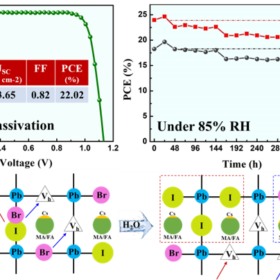
Moisture-resistant perovskite cell with 22.02% efficiency
Scientists in China have used a fluorine-containing Lewis acid treatment to develop a perovskite cell that is said to retain between 63% and 80% of its initial efficiency after 14 days under 75% and 85% relative humidity.
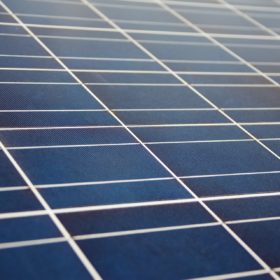
Chilean energy provider aims to build 788 MW solar park
Colbún has applied for approval to build a 788 MW solar project in Chile’s northern region of Antofagasta.

Hanwha officially exits polysilicon business
Hanwha Solutions has confirmed that it will shut down its polysilicon business over the course of the next year, only a week after saying that it was still evaluating its plans for the sector.

Vietnam might maintain FITs for 3 GW of approved large-scale PV projects
The transition from a feed-in tariff scheme to an auction mechanism may take longer than expected in the Southeast Asian country, as the Ministry of Industry and Trade is considering maintaining FITs of $0.0709/kWh to $0.0769/kWh for projects that secured approval before Nov. 23, 2019, if they come online as scheduled by the end of this year. According to law firm Lexcomm Vietnam, there are currently 3 GW of projects with licenses.
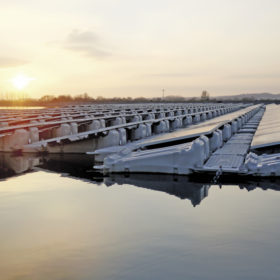
Is thin-film best for offshore PV?
Superior hydrodynamic properties, more robustness in high seas and a much reduced logistics requirement support the case for thin-film over crystalline silicon, pontoon-mounted alternatives, according to an Indo-Italian research group.

Ghana’s first bilateral solar PPA
Plastic manufacturer Miniplast will buy electricity from a 704 kW grid-connected solar array owned and operated by Norwegian developer Empower New Energy AS.

Italian car factory to add 15 MW of solar and 850 charging points
Carmaker Fiat Chrysler is bringing solar power to its Mirafiori manufacturing hub in Turin. A rooftop array will be installed by the auto giant with EDF-owned energy company Edison. French group Engie will install electric vehicle charging points in the car park.
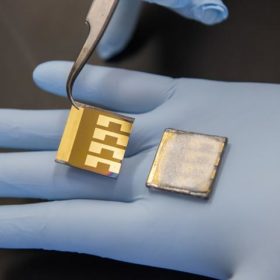
Preventing lead leakage in perovskite cells
A U.S. research group has used a lead-absorbing material to coat the front and rear of a perovskite solar cell stack. The researchers claim the films captured 96% of lead leakage when the cells were damaged.

New layer raises efficiency of heterojunction solar cells
A Dutch research team has used highly transparent, hydrogenated nanocrystalline silicon oxide layers to improve the optoelectrical performance of contact stacks in a silicon heterojunction device. The material is said to offer superior electrical as well as favorable optical properties.
