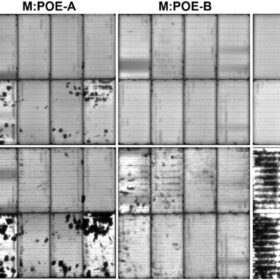
Not all POE encapsulants protect TOPCon solar cells from corrosion
UNSW researchers found that some POE encapsulants can trigger severe corrosion in TOPCon solar modules, causing up to 55% power loss under damp-heat conditions. Their study highlights that module reliability depends on the exact encapsulant formulation, not just the polymer type.
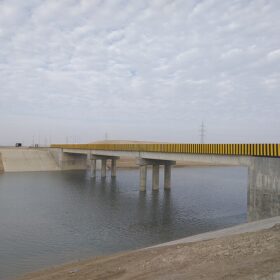
Canal-top PV for Afghanistan’s massive irrigation project
A team of scientists has simulated covering 20% of the Qush-Tepa irrigation canal with PV panels. To this end, the researchers developed a framework, termed an integrated techno-economic-environmental assessment, that can be applied elsewhere. “It explicitly quantifies energy production, water-evaporation reduction, land-use savings, and economic performance within a single analytical structure,” one of the researchers said.
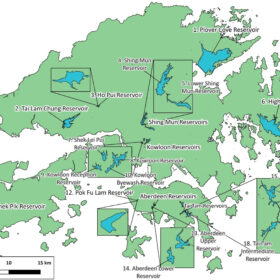
Floating PV could power up to 490,000 households in Hong Kong
Hong Kong has limited land, and researchers have checked how much of the city can be powered if most of its water reservoirs were to be fully or partially covered with floating PV systems. At best, full coverage can supply more than 15% of the city’s total demand, and more than 60% of the residential demand.
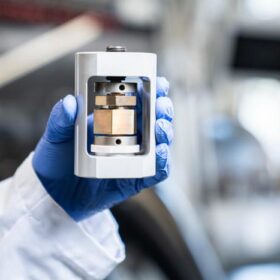
Swiss researchers improve electrolyte design for long-life solid-state batteries
A Swiss research team has developed a low-temperature sintering and interface-coating process that significantly improves the durability of argyrodite-based solid-state batteries. The approach delivers high ionic conductivity and long cycle life, retaining 75% of capacity after 1,500 cycles.
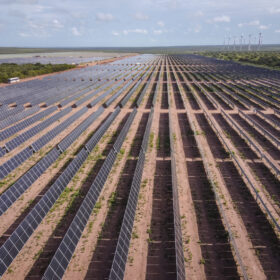
Capex-driven strategies can reduce solar LCOE by 20%
An international research group has conducted a literature review of capital expenditure-driven levelized cost of electricity optimization strategies for utility-scale PV systems. Tracking optimization, system voltage escalation, and advanced system design are identified as the most promising cost reduction areas. “The next wave of PV research must be LCOE-native, system-level, and deployment-validated,” a member of the research group said.

New multi‑hotspot detection tech based on Lab* feature descriptor
A Husqvarna researcher developed a fast, interpretable PV hotspot-detection method using IR thermography and Lab* color-space features instead of heavy neural networks, achieving up to 95.2% accuracy with shallow classifiers. The lightweight system works in real time on drones or edge devices and could save 17,620 kWh and 8.9 tons of CO₂ annually by improving fault detection in solar panels.

Mibet releases mounting system for flat-roof PV installations
The Chinese company said its novel Z-type mounting supports installation angles of 5°, 10°, and 15° and withstands wind speeds up to 45 m/s. It claims a lifespan of more than 25 years.
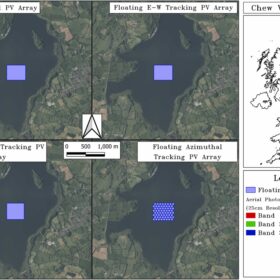
UK study finds azimuthal trackers boost floating PV performance
A University of Exeter team has tested single-axis tracking systems for floating solar across 12 UK sites, finding azimuthal tracking delivers the largest energy gains and lowest levelized cost of energy (LCOE).
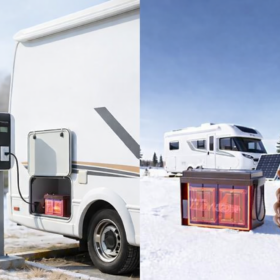
LiTime launches 320 Ah LiFePO4 battery with 4,096 Wh capacity
Chinese battery maker LiTime has introduced its 12V 320Ah Mini Smart Self-Heating Battery, offering 4,096 Wh of energy capacity and 2,560 W of continuous output power.
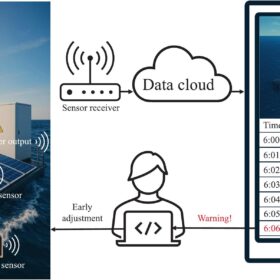
New digital twin for floating PV application uses artificial intelligence
Scientists have developed a floating PV digital twin system, trained on data from 155 physical experiments, using a two-tier artificial neural network (ANN) with a high-fidelity model and a reduced-order model. Predictive performance reached R2 values of 0.9996 for PV surface temperature and 0.9189 for power output.
