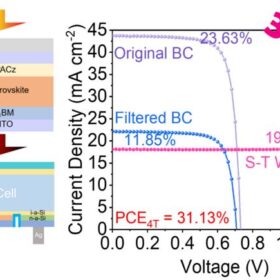
Chinese scientists build 31.13%-efficient perovskite-silicon tandem solar cell via 2D seeding agent
Researchers in China developed a novel two dimensional (2D) seeding agent to regulate crystallization in a 1.80-eV wide-bandgap perovskite film. A perovskite-silicon tandem device made with the resulting optimized subcell achieved an efficiency of 31.13%, outperforming a control device.

Researchers achieve record perovskite solar module stability under light, heat, and UV stress
An international research team has developed a new two-dimensional perovskite interlayer based on a co-crystal engineering strategy for more robust perovskite films. It demonstrated improved performance in small area perovskite solar cells and, in a 48 cm2 module, contributed to retain 95% of initial efficiency after 5,000 h.
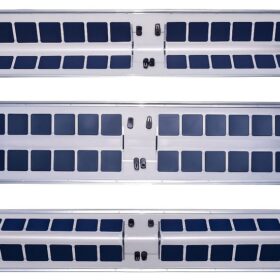
Mirai Solar develops lightweight solar panel for agrivoltaics
While completing pilot projects in the U.S. and Europe, Mirai Solar has certified its lightweight PV module designed to work as a shade screen in agrivoltaics applications, such as greenhouses.
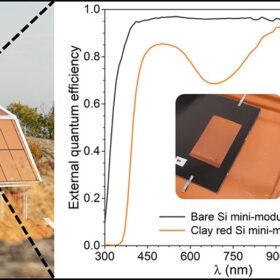
Danish researchers develop color-tunable BIPV foil
The use of a novel roll-to-roll process and optimization technology resulted in polymer foils for use in colored PV modules in a potentially wide range of colors with low iridescence and low levels of efficiency loss.
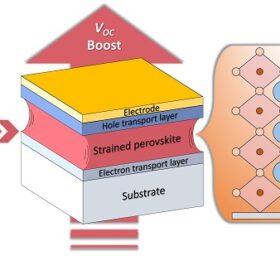
EPFL researchers enhance perovskite solar cell performance via rubidium
Researchers led by Michael Grätzel at the Ecole Polytechnique Federale de Lausanne in Switzerland have recently led efforts to improve perovskite optoelectronic properties using small-radius rubidium ion chemistry to enable more stable and efficient perovskite solar cells.

ML System unveils solar facade panels, roof-integrated PV tiles
The Poland-based module manufacturer has developed Photonwall, a building integrated solution for ventilated façades. It also offers Photonroof, a ceramic PV roof tile solution. Both BIPV products are available in colors and finishes that match the aesthetics of modern and historic buildings.
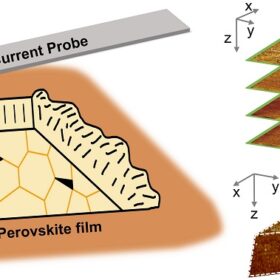
New research sheds light on defect regions in perovskite solar films
A Chinese research group has demonstrated an electrical imaging technique using 3D tomographic conductive atomic force microscopy to investigate passivation strategies of perovskite films to improve stability and efficiency of perovskite solar cells.

Japanese airport terminal hosting chalcopyrite solar modules
In two separate projects Japan-based Kyuden Mirai Energy and Nissan Motor are demonstrating the use of flexible, glass-free chalcopyrite PV panels provided by PXP Corporation.

Flexible front cover tested for glass-free CIGS devices
Researchers in Japan have developed an effective encapsulation with a PET front cover for copper indium gallium diselenide mini-modules. The lab devices withstood damp heat tests, retaining approximately 97 % of initial efficiency after 3,600 h.

Leecell develops organic PV for indoor, outdoor use
The South Korean startup is developing organic solar cell technology made using a proprietary roll-to-roll process. It targets both indoor and outdoor integrated PV applications.
