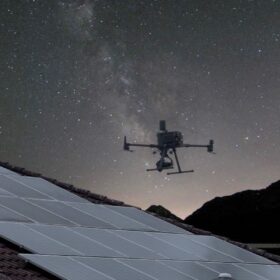
Drone-based electroluminescence services for rooftop PV
Solevi, a German electroluminescence (EL) inspection company, has launched drone-based electrical inspection services for rooftop solar installation in Germany with plans to automate further and expand geographically.

Webasto unveils vehicle-integrated PV system covering rear window, roof area
Webasto, a German automotive industry supplier and developer of vehicle integrated PV, unveiled a new sun roof system concept with components that are 40% lighter and a capacity of 350 kWh per year.
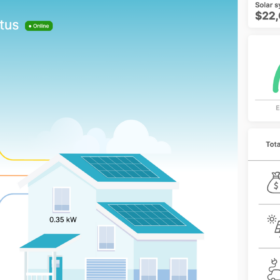
Enact Systems expands PV installer, buyer platform
The US-based platform for buyers and installers of solar and energy storage projects has added several new productivity features, as well as German and Spanish language support. It also has some additional third-party application program interface (API) integrations.
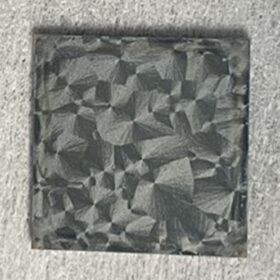
Terpyridine-passivated perovskite solar cells achieve 25.24% efficiency
An international team of researchers demonstrated perovskite solar cells treated with a molecular passivator based on π-conjugated terpyridine Lewis-base molecules that achieved 25.24% power conversion efficiency, with 90% retained after 2,664 hours of light exposure. The treatment reportedly works at high concentrations without damaging the perovskite film or diminishing cell performance. A protocol was published to reproduce the results, opening the door to testing it on a range of perovskite absorbers.
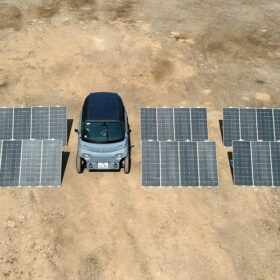
Citroën lightweight compact EV equipped with solar kits
La Croisière Verte is the name of a 13,500 km expedition from the north to south of Africa in a fleet of four Citroën AMI vehicles, each carrying 5,600 W of lightweight PV panels in foldable packs.

Chinese PV Industry Brief: JA Solar, TCL, Tongwei, GCL Technology post H1 losses
JA Solar has reported a net loss of CNY 874 million ($123.3 million) for the first half of 2024, while Tongwei posted a loss of CNY 3.13 billion. TCL Zhonghuan and GCL Technology also recorded losses of CNY 3.06 billion and CNY 1.48 billion, respectively.
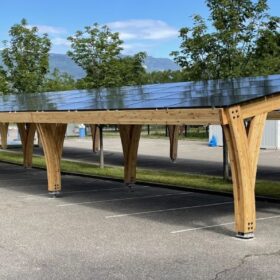
Timber framed solar carports for residential, commercial applications
Sweden-based Innoventum has launched a solar carport line equipped with bifacial modules in a larch wood structure. The solution may include electric vehicle charging, energy storage, LED lighting, and inverter systems.
Chinese PV Industry Brief: JinkoSolar, Longi, Trina Solar report H1 results
JinkoSolar says it recorded CNY 47.251 billion ($6.6 billion) of revenue and a CNY 1.2 billion net profit in the first half of 2024, while Longi’s revenue plunged to CNY 38.529 billion in the January-June period, with a net loss of CNY 5.243 billion.
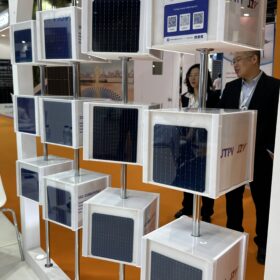
Scientists estimate material demand for all silicon PV module technologies by 2050
Dutch researchers used dynamic modelling to uncover the demand for silicon-based PV materials used in a wide range silicon PV technologies, including perovskite-silicon tandem and back-contact modules. The model included calculating the impact of advances in module efficiency and material intensity, as well as circular closed loop recycling.
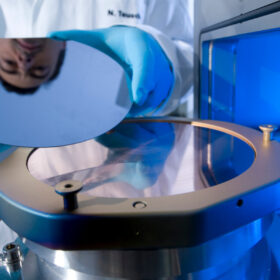
Fraunhofer CSP developing new patent infringement investigation methods for PV technologies
The German research institute is working on developing advanced, high-resolution material and thin film characterization methods that may become a set of simplified and rapid measurement procedures for routine use in intellectual property investigations.
