
UK rooftop solar installations surge, new battery storage record set
Latest MCS data for small-scale renewables reveal a strong month for solar installations up to 50 kW, double-digit growth for battery energy storage installations and a milestone reached despite a muted month for heat pump installations.
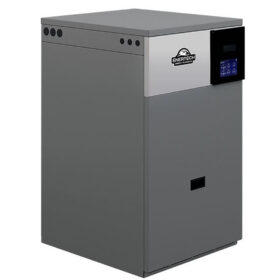
Enertech unveils geothermal heat pump for residential use
The US-based heating specialist said its new variable-speed water–to–water system has a coefficient of performance of 3.2 at full load and 3.8 at part load.

Coupling heat pumps with district heating
Researchers in Sweden have analyzed the impact of a hybrid heating system combining heat pumps and district heating on five real buildings. The analysis showed that residents were able to save up to €2,768 ($3,159) compared to a scenario without source coupling.

CSP-driven multigeneration system combines hydrogen generation with compressed air, pumped hydro storage
Researchers have designed a novel multigeneration energy system that provides five outputs, namely electricity, hydrogen, cooling, heating, and hot water. The system is mainly powered by a solar heliostat system and incorporates compressed air and pumped hydro storage technologies for storing surplus power.

Testing 54 different combinations of solar-assisted heat pumps
Researchers in Germany have modeled dozens of indirect-expansion solar-assisted heat pump systems using photovoltaic-thermal panels for single-family homes in Munich, Berlin, and Hamburg. Simulations accounted for local weather, electricity use, and thermal demand.
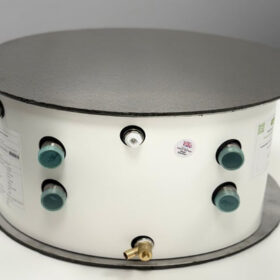
Hewer launches pre-assembled unit for heat pump retrofit, installation
The UK-based heating solutions provider has developed a pre-engineered and ready-to-install unit compatible with most of the residential heat pumps available in the market. It can be placed underneath a standard hot water cylinder and transfer heat from the pump via a plate exchanger to the central heating indirectly.
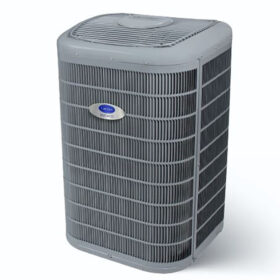
Carrier debuts residential heat pump for cold climates
The U.S. heating specialist said its new heat pump system can operate “reliably” at -30 C and achieve 100% heating capacity at -17 C, with full cooling capacity being achievable at 50 C.

GE Appliances unveils residential hybrid heat pump water heater
The U.S. manufacturer said its new heat pump water heater can provide up to 60% more hot water than standard electric water heaters. The system is available in 240 V and 120 V options and with a capacity ranging from 160 L to 190 L.
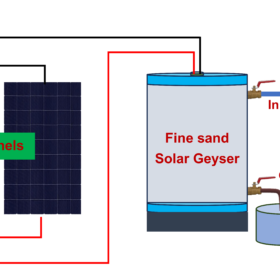
PV-powered fine sand solar geyser for domestic hot water
The system is described by its creators as a cost-effective solution for water heating by storing thermal energy in fine sand. Techno-economic analysis indicated the system is economically viable for domestic water heating applications, with an initial capital cost of $278 and an expected lifespan of 25 years.
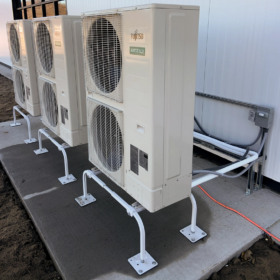
How to optimize heat exchangers in heat pumps
Scientists have developed a new model for heat exchangers of heat pumps, combining strengths of numerical modeling and machine learning.
