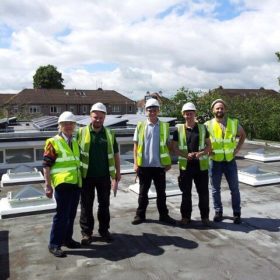
Scotland issues EoI for energy efficiency measures including PV-plus-storage
The “Energy Efficient Scotland Transition Programme: Decarbonisation Fund for Social Housing” is aimed at helping building owners to improve the energy efficiency of homes and buildings in the commercial, public and industrial sectors.

Dutch government to improve SDE+ program for sub-1 MW PV projects
The Netherlands government intends to create two more ad hoc categories for solar projects not exceeding 1 MW, and to grant them a higher level of incentive compared to those of big solar parks. The change is due the success of larger projects in previous SDE+ rounds.
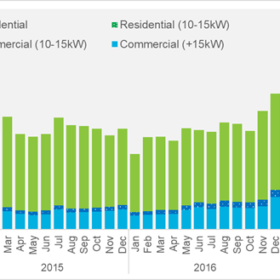
100 MW months emerge as the new normal for small-scale PV installs Down Under
Green Energy Markets’ small-scale solar figures for April reveal that above 100 MW is emerging as the new normal for monthly installations in the segment in 2018. While the month was below the record-setting 127 MW in March, April’s 109 MW indicates that installations north of 100 MW is new normal for the Australian residential and small commercial sector.

Hungary unexpectedly terminates FIT for PV projects ranging from 50 to 500 kW
The Hungarian government has amended its recently issued support scheme METAR, in order to introduce a tight deadline for residential and commercial PV, which will, in reality, mean the end of most of projects in this segment. The METAR scheme had been approved by the European Commission last summer.

The Weekend Read: Three questions facing Indian solar
PV in India: The seemingly serene solar journey that India was on has hit stormy waters in recent months as issues regarding tariff duties, domestic content and financial backing have served to shake confidence in the industry. But there still exists fantastic potential across the nation for PV to really embed itself as India’s favored power source, provided it can address these three key questions.
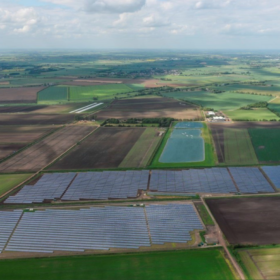
Lightsource BP, UK water utility partner for 10 solar farms
U.K.-based water company, Northumbrian Water has entered into a partnership with Lightsource BP for the development of 10 new solar farms at its sites, which are expected to generate 10 GWh of clean electricity each year to help power its operations.
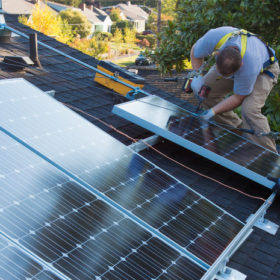
Four-junction tandem thin film cells have strong potential for residential applications, MIT scientists say
Four different thin film solar PV technologies were tested by the MIT experts across three types of environment in the U.S.: Arid (Arizona); temperate (South Dakota); and humid (Florida).
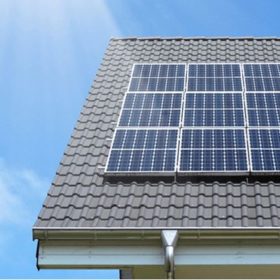
ReneSola sells stake in China DG solar business for $31.5 million
ReneSola Ltd has sold a 40.13% stake in its Zhejiang ReneSola Investment Limited subsidiary, which deals with its distributed generation (DG) solar PV projects in China.
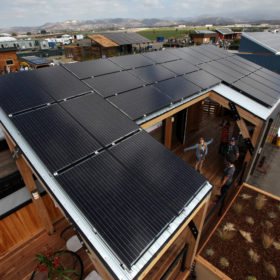
Ontario earmarks $70 million for solar, storage rebates
Under the GreenON’s Solar Rebates Program, homeowners will be able to install solar-plus-storage systems with a capacity of up to 10 kW, while businesses will be entitled to deploy up to 500 kW of rooftop PV capacity.
Canadian Solar to develop up to 300 MW of solar in EMEA region
Canadian Solar Inc. has signed an agreement with Global Investment Holdings (GIH) to develop up to 300 MW of solar PV projects in Europe, the Middle East and Africa.
