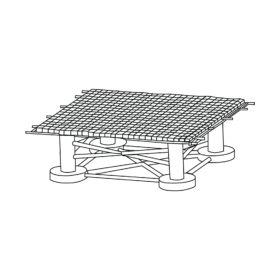
New modular design for offshore floating photovoltaic platforms
A team of scientists from China and the United States studied ways to optimize floating photovoltaics for offshore use. It found that the robustness of the systems was influenced by the size and number of platforms, as well as the types of connections between platforms.

Tests show rooftop fires propagate slowly with vertical PV systems
New tests conducted by the Slovenian National Building and Civil Engineering Institute have shown that vertical PV installations offer improved fire safety compared to conventional diagonal or flat solar arrays. The experiment showed, in particular, how rapidly a fire can propagate under inclined panels.
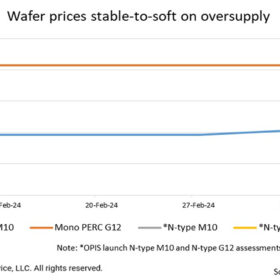
Wafer prices stable-to-soft on market oversupply
In a new weekly update for pv magazine, OPIS, a Dow Jones company, offers bite-sized analysis on solar PV module supply and price trends.

Quantifying effect of cooling, cleaning in PV systems operating under desert conditions
Scientists in Oman have analyzed the effect of soiling, cleaning, and water injection on the performance of PV panels in Oman. They have found the use of water for cooling may increase power yield by up to 23.9%.
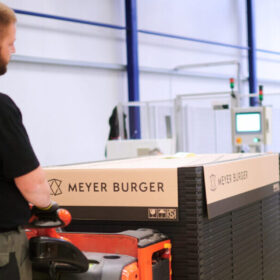
Meyer Burger reports $330 million loss for fiscal 2023
Switzerland-based Meyer Burger had a PV module inventory of 365 MW at the end of 2023. The closure of its panel factory in Freiberg, Germany, will only be reversed if there are very strong political signals, said CEO Gunter Erfurt.

After-sale support key to boosting off-grid solar
A new survey from US-based impact measurement company 60 Decibels shows off-grid energy customers are currently facing a series of challenges such as product affordability, gender inequality, customer support, further investment in minigrids, and over-indebtedness. The report, however, reveals that most users say the quality of their lives “very much improved” thanks to off-grid PV.

Solarever presents 410 W all-black solar panel
Mexican manufacturer Solarever says its new passivated emitter and rear cell (PERC) PV module has an efficiency of 20.97% and a temperature coefficient of -0.35% per degree Celsius.
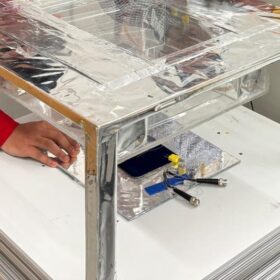
U.S. scientists build hybrid energy system integrating PV, radiative cooling
The hybrid system has a cooling power of 63.8 W/m2 and a photovoltaic power output of 159.9 W/m2. According to its creators, the cooling capacity provided by the system can be used in buildings or refrigerators.
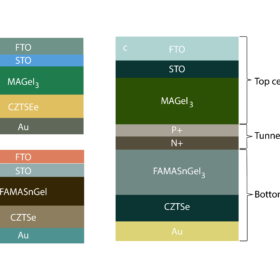
Tandem perovskite-perovskite solar cell integrating kesterite shows potential efficiency of 23.32%
The simulated tandem cell integrates a hole transport layer made of kesterite and lead-free perovskite materials. Its creators claim the combined device performs better than the individual cells it embeds.

Dynamic photovoltaic blinds for glaze-façade buildings
Scientists from China have built photovoltaic blinds that can reportedly regulate thermal load, daylight penetration, and energy generation in high-rise buildings with glazed facades. Their creators claim the blinds offer superior architectural aesthetics and notable energy-saving potential.
